Editorial · pp. 9–15
Why Energy, Intelligence and Complex Systems Must Be Studied Together
Alexander Bykovski · EnergeticaX Institute, Abu Dhabi
Introduces the mission of EX-JICS and argues that engineering, sustainability and intelligent-technology research now requires an interdisciplinary approach centred on reliable decision-making.
Read full text →
Research Article · pp. 16–22
Why Some Investment Bubbles Build the Future
Alexander Bykovski · EnergeticaX Institute, Abu Dhabi
Proposes the concept of the search function of capital: under technological uncertainty, capital doesn't just allocate — it explores multiple competing futures at once, occasionally leaving durable infrastructure behind.
Read full text → DOI: 10.XXXXX/ex-jics.2026.001
Research Article · pp. 23–33
Semantic Compression, Cognitive Compatibility, and Meaning Drift in Human–AI Systems
Alexander Bykovski · EnergeticaX Institute, Abu Dhabi
Argues that so-called 'secret AI prompts' are not hidden control mechanisms but semantic compression, whose effectiveness depends on shared context and cognitive compatibility.
Read full text → DOI: 10.XXXXX/ex-jics.2026.002
Research Article · pp. 34–48
A New Perspective on Institutional Adaptation in Complex Information Environments
Alexander Bykovski · EnergeticaX Institute, Abu Dhabi
Introduces Information Density and Institutional Lag to explain why institutions increasingly struggle to keep pace with rapidly growing informational complexity.
Read full text → DOI: 10.XXXXX/ex-jics.2026.003
Research Article · pp. 49–78
A Unified Framework for Meaning Formation, Decision Reliability, and Human–AI Compatibility
Alexander Bykovski · EnergeticaX Institute, Abu Dhabi
A unified conceptual architecture linking Information Density, Semantic Compression, the ψ-operator, nœm units, Human–AI Compatibility and Decision Reliability.
Read full text → DOI: 10.XXXXX/ex-jics.2026.004
Perspective · pp. 79–85
And the Future Belongs to Those Who Unite Both
Alexander Bykovski · EnergeticaX Institute, Abu Dhabi
Argues that AI amplifies existing cognitive architecture rather than creating thinking — making accumulated professional experience more valuable, not less, in the AI era.
Read full text →
A note on this inaugural issue. Issue 1 is intentionally composed of invited contributions prepared by the founding editorial team, establishing the journal's scientific direction and editorial standards. Beginning with Issue 2, EX-JICS opens to external submissions through its regular peer-review process. See About the Journal and Editorial Policies for details.
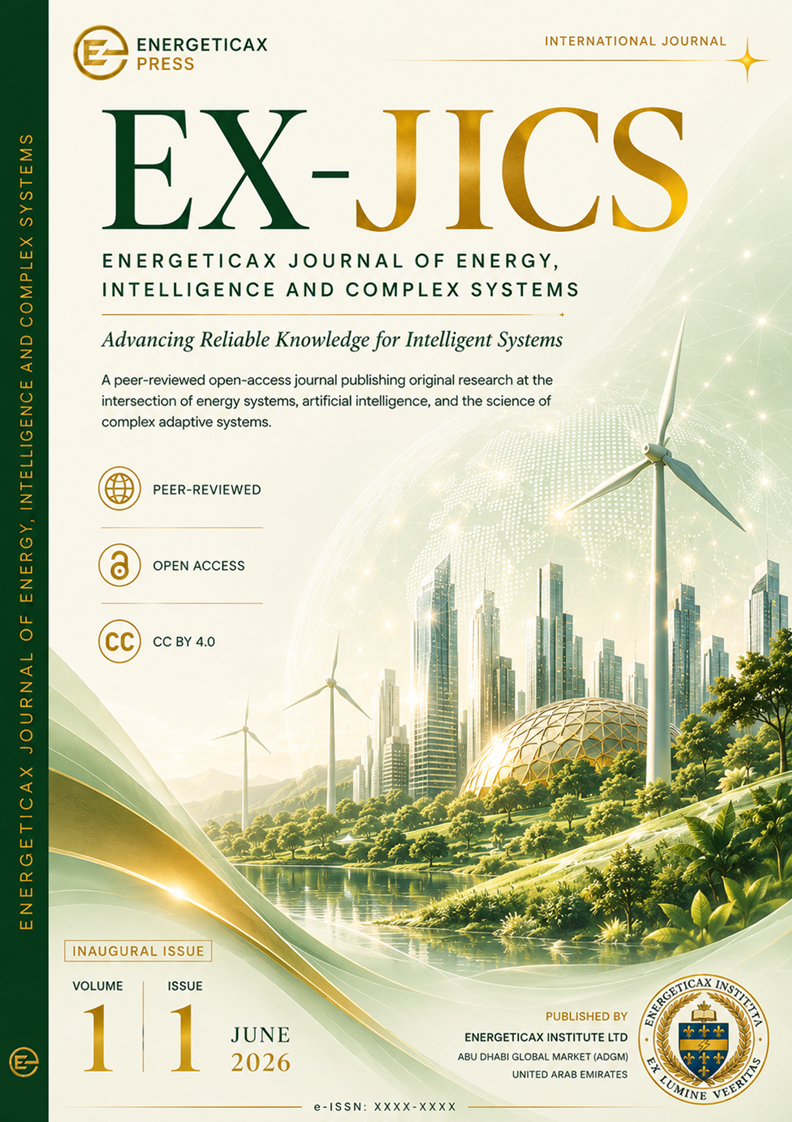
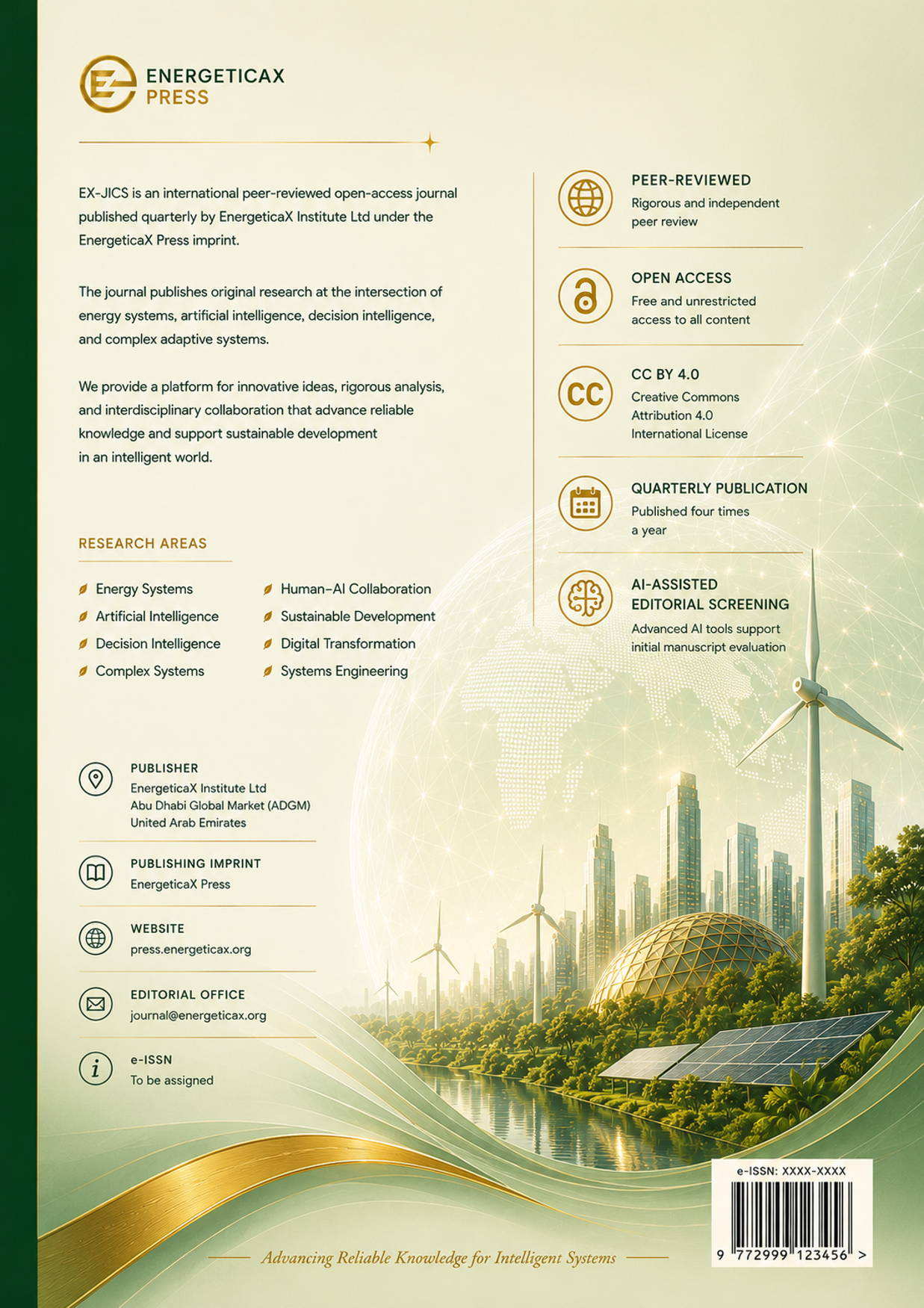
Front and back cover of this issue. The back cover (imprint, ISSN barcode, research areas) is refreshed for every new issue; the front cover keeps the EX-JICS masthead with an issue-specific illustration.