The NOEM Research Program
A Unified Framework for Meaning Formation, Decision Reliability, and Human–AI Compatibility — Research Article, Vol. 1 No. 1
Volume 1 • Issue 1 • June 2026
The NOEM Research Program
A Unified Framework for Meaning Formation, Decision Reliability, and Human–AI Compatibility
Alexander Bykovski, EnergeticaX Institute
Correspondence: journal@energeticax.org
Abstract
Artificial intelligence has dramatically expanded the computational capabilities of modern decision-making systems. Yet improvements in model performance have not consistently produced corresponding improvements in decision reliability. Increasing model size, larger datasets, and more sophisticated architectures enhance statistical prediction, but they do not necessarily ensure stable understanding, semantic consistency, or reliable interaction between fundamentally different cognitive systems.
This paper introduces the NOEM Research Program as a unified conceptual framework explaining how information is transformed into stable meaning and subsequently into reliable decisions through entropy-regulated interaction between human and artificial cognition. Rather than treating meaning as a secondary consequence of information processing, the proposed framework places meaning formation at the center of cognitive interaction.
The framework integrates several complementary concepts developed throughout this research program, including Information Density, Semantic Compression, Question Competence, the ψ-operator, the nœm unit, Human–AI Compatibility, and Decision Reliability. Together these concepts describe a continuous process through which information acquires context, context becomes meaning, meaning enables compatibility, and compatibility supports reliable decision-making.
Within this perspective, artificial intelligence is understood not primarily as a generator of responses but as a participant in a shared process of meaning construction. Consequently, the reliability of AI-assisted decisions depends less on computational power than on maintaining semantic stability throughout interaction.
The article further introduces Meaning Artificial Intelligence (MAI) as a future direction for adaptive cognitive systems and proposes a transition from model-centered artificial intelligence toward meaning-centered cognitive architectures.
The NOEM Research Program establishes a conceptual foundation for future interdisciplinary research spanning artificial intelligence, decision science, institutional governance, economics, cognitive systems, and Human–AI collaboration.
Highlights
Introduces the NOEM Research Program as a unified conceptual architecture for meaning formation and decision reliability.
Integrates Information Density, Semantic Compression, Question Competence, Human–AI Compatibility, and Decision Reliability into a coherent theoretical framework.
Proposes Meaning Artificial Intelligence (MAI) as a future paradigm of adaptive cognitive systems based on semantic stability rather than computational scale.
Research Context
Research on artificial intelligence has traditionally focused on improving computational performance, predictive accuracy, and statistical learning. Parallel developments in information theory, cognitive science, institutional economics, and decision theory have generated valuable insights into communication, reasoning, and organizational adaptation. However, these disciplines have largely evolved independently, each explaining only a fragment of the broader process through which reliable understanding emerges.
The NOEM Research Program proposes an integrative conceptual architecture that connects these previously separate perspectives. Rather than introducing another computational model, the framework seeks to explain how meaning is formed, stabilized, transferred, and transformed into reliable decisions across interacting cognitive systems.
In this sense, the present article does not propose a replacement for existing theories. Instead, it offers a higher-level conceptual framework capable of integrating their contributions into a common language centered on meaning, compatibility, and adaptive cognition.
Keywords
NOEM Framework; Meaning Formation; Human–AI Interaction; Decision Reliability; Information Density; Semantic Compression; Cognitive Compatibility; Meaning Artificial Intelligence.
1. Introduction
For more than seventy years, the development of information technologies has been guided by a central assumption: increasing computational capability inevitably leads to better decision-making. Each new generation of computing systems has expanded humanity's capacity to store information, process data, recognize patterns, and generate increasingly sophisticated predictions.
The emergence of large language models appears to represent the culmination of this trajectory. Modern artificial intelligence systems demonstrate remarkable abilities in language generation, reasoning, programming, scientific assistance, and creative problem-solving. Their performance on standardized benchmarks continues to improve at an extraordinary pace.
Yet a paradox has become increasingly apparent.
Despite unprecedented computational power, interactions between humans and artificial intelligence frequently produce misunderstanding, semantic drift, inconsistent reasoning, and unreliable decisions. Different users obtain contradictory answers to identical questions. Correct information may produce incorrect conclusions. Highly capable models may confidently generate responses that are logically coherent yet semantically incompatible with the intentions of the user.
These observations suggest that computational capability alone cannot explain decision reliability.
The central challenge is no longer the production of information.
Nor is it simply the generation of statistically probable responses.
Instead, the critical challenge concerns the formation of shared meaning between interacting cognitive systems.
Information can be transmitted without being understood.
Knowledge can be accumulated without producing coherent action.
Correct answers may fail to solve the actual problem if they emerge from incompatible interpretations of meaning.
This observation motivates the central proposition of the present work.
Reliable decisions arise not merely from information processing but from the successful formation, stabilization, and preservation of meaning throughout cognitive interaction.
The NOEM Research Program is proposed as a unified conceptual framework describing this process.
Rather than treating meaning as a subjective consequence of communication, the framework considers meaning to be an adaptive property emerging through interaction between cognitive systems operating under conditions of uncertainty, informational complexity, and continuous environmental change.
Within this perspective, semantic stability becomes the primary prerequisite for decision reliability, while Human–AI Compatibility becomes a measurable property of successful cognitive interaction.
The objective of this article is therefore not simply to introduce another theoretical model.
Its purpose is to establish a common conceptual architecture capable of integrating meaning formation, information density, semantic compression, compatibility, and adaptive decision-making into a coherent interdisciplinary research program.
2. The Reliability Paradox
The remarkable progress of artificial intelligence has fundamentally transformed expectations regarding the future of human decision-making. Contemporary AI systems demonstrate levels of performance that, only a decade ago, appeared unattainable. They generate coherent language, assist scientific research, solve complex programming tasks, and increasingly participate in professional decision-making across medicine, engineering, finance, education, and public administration.
From a technological perspective, this progress is extraordinary.
Yet a paradox has emerged.
Despite continuous improvements in computational capability, the reliability of decisions supported by artificial intelligence has not increased proportionally.
More powerful models frequently produce more convincing explanations without necessarily producing more reliable understanding.
Additional information often generates greater uncertainty rather than greater clarity.
Increasing computational complexity may improve prediction while simultaneously reducing interpretability.
These observations suggest that computational performance and decision reliability are not equivalent.
The distinction becomes particularly visible during Human–AI interaction.
A language model may generate a statistically probable response that satisfies grammatical, logical, and contextual expectations while nevertheless failing to capture the intended meaning of the user's question.
Conversely, relatively simple interactions may produce highly reliable decisions when both participants share compatible semantic frameworks.
This contradiction indicates that reliable decision-making depends upon factors extending beyond computational inference alone.
The central challenge therefore shifts from how artificial intelligence generates responses to how interacting cognitive systems establish shared meaning.
From this perspective, decision reliability becomes an emergent property of successful cognitive interaction rather than an intrinsic characteristic of any individual intelligence, whether human or artificial.
The Reliability Paradox may therefore be formulated as follows:
Increasing computational intelligence does not necessarily produce increasing decision reliability unless meaning remains stable throughout cognitive interaction.
This proposition forms the starting point of the NOEM Research Program.
Rather than seeking progressively larger models, the framework investigates the conditions under which information becomes stable meaning and meaning becomes reliable action.
Definition 1. The Reliability Paradox
The Reliability Paradox describes the phenomenon in which continuous improvements in computational capability and information processing do not necessarily produce corresponding improvements in decision reliability because reliable decisions depend primarily on semantic stability established during cognitive interaction.
Editorial Transition
The Reliability Paradox naturally raises a fundamental theoretical question.
If computational intelligence alone cannot explain reliable understanding, then which existing scientific frameworks are capable of explaining how stable meaning emerges during interaction between cognitive systems?
The following section examines this question by considering the contributions—and limitations—of several influential theoretical traditions.
3. Beyond Information Theory
The rapid development of artificial intelligence has stimulated renewed interest in fundamental questions concerning information, cognition, communication, and decision-making. During the past century, several influential theoretical traditions have profoundly shaped our understanding of these phenomena.
Information theory explains how signals are transmitted.
Cognitive science explains how organisms process information.
Decision theory explains how choices are made under uncertainty.
Artificial intelligence explains how statistical models approximate complex patterns.
Institutional theory explains how organizations adapt to changing environments.
Each of these perspectives has contributed essential insights.
However, each primarily examines one stage of a broader cognitive process.
The present study argues that reliable decision-making cannot be fully understood unless these traditionally separate perspectives are considered within a unified conceptual architecture centered on meaning formation.
3.1 Information Is Not Meaning
The mathematical theory of communication developed by Claude Shannon transformed modern information science by demonstrating how information can be efficiently encoded, transmitted, and reconstructed despite noise.
Its extraordinary success established information as a measurable quantity independent of semantic interpretation.
This abstraction proved essential for telecommunications, computer science, digital networks, and modern computing.
However, Shannon himself explicitly distinguished information from meaning.
The mathematical framework intentionally excluded semantic interpretation in order to focus on communication efficiency.
Consequently, two systems may exchange information perfectly while nevertheless constructing entirely different meanings from the same transmitted signals.
The distinction between successful transmission and successful understanding therefore remains outside the explanatory scope of classical information theory.
For cognitive interaction, this distinction becomes fundamental.
Reliable decisions depend not merely on whether information reaches another cognitive system, but on whether both systems construct sufficiently compatible meanings from that information.
3.2 Intelligence Is Not Compatibility
Research in cognitive psychology and artificial intelligence has greatly expanded our understanding of reasoning, learning, and problem solving.
Large language models demonstrate remarkable abilities to generate coherent responses by identifying statistical regularities within enormous textual corpora.
These systems increasingly approximate human performance across diverse intellectual tasks.
Nevertheless, impressive reasoning capabilities do not necessarily guarantee semantic compatibility between interacting cognitive systems.
Different individuals frequently interpret identical responses in different ways.
Likewise, identical prompts may generate different interpretations depending upon context, prior knowledge, intentions, or conversational history.
Consequently, increasing intelligence alone does not eliminate misunderstanding.
Compatibility emerges through successful coordination of meaning rather than through computational capability alone.
3.3 Prediction Is Not Reliable Understanding
Contemporary machine learning systems excel at prediction.
Probability distributions allow language models to estimate highly plausible continuations of text.
Predictive success, however, should not be confused with reliable understanding.
A statistically probable response may remain semantically inappropriate for the decision context.
Conversely, relatively improbable interpretations may occasionally provide deeper explanatory insight.
Reliable understanding therefore cannot be reduced to statistical prediction alone.
Instead, it depends upon maintaining semantic coherence throughout cognitive interaction.
This distinction becomes increasingly important as artificial intelligence participates in scientific research, public administration, healthcare, education, engineering, and strategic governance.
3.4 Toward a Meaning-Centered Framework
The preceding discussion suggests that existing theoretical traditions explain complementary aspects of cognition without fully addressing the formation of shared meaning itself.
Information theory explains transmission.
Artificial intelligence explains prediction.
Decision theory explains choice.
Institutional theory explains adaptation.
Yet none of these frameworks places meaning formation at the center of analysis.
The NOEM Research Program proposes that meaning should be understood not as a secondary consequence of information processing but as the primary mechanism through which reliable interaction between cognitive systems becomes possible.
Within this perspective, information constitutes the input of cognition.
Meaning represents its adaptive organization.
Compatibility determines whether independently constructed meanings remain sufficiently aligned to support reliable collective decisions.
This shift from information-centered analysis toward meaning-centered analysis provides the conceptual foundation for the NOEM Architecture presented in the following section.
Editorial Transition
The recognition that reliable decisions depend upon stable meaning rather than information alone naturally raises the next question:
How does meaning emerge from information during interaction between cognitive systems?
The NOEM Architecture proposed below addresses this question by describing the successive stages through which information becomes meaning, meaning establishes compatibility, and compatibility enables reliable decision-making.
4. The NOEM Architecture
The preceding discussion suggests that reliable decision-making cannot be explained solely by information processing, computational capability, or predictive performance. These elements remain necessary, but they do not fully account for how stable understanding emerges between interacting cognitive systems.
The NOEM Research Program proposes that the missing explanatory layer is meaning formation.
Within the proposed framework, meaning is not treated as a subjective interpretation added after communication has occurred. Instead, meaning is understood as an adaptive organizational property that emerges during interaction between information, context, cognitive structures, and environmental constraints.
Reliable decisions therefore do not arise directly from information.
They emerge through successive stages of cognitive organization.
Information becomes structured within context.
Context generates interpretable meaning.
Meaning establishes compatibility.
Compatibility enables reliable collective decisions.
This sequence constitutes the central architecture of the NOEM Research Program.
Unlike traditional linear models of communication, the NOEM Architecture assumes continuous interaction among multiple adaptive cognitive systems. Meaning is therefore continuously reconstructed rather than simply transmitted.
Consequently, decision reliability depends less on the quantity of exchanged information than on the stability of meaning maintained throughout this interactive process.
The framework proposed here should therefore be understood as a conceptual architecture describing how information acquires operational significance during interaction between human and artificial cognition.
Definition 1. The NOEM Framework
The NOEM Framework is a unified conceptual architecture describing how information is transformed into stable meaning and subsequently into reliable decisions through adaptive interaction between cognitive systems operating under conditions of uncertainty, informational complexity, and continuous environmental change.
Unlike computational models that primarily optimize prediction, the NOEM Framework focuses on the emergence, preservation, and compatibility of meaning across interacting cognitive agents.
4.1 The Architecture of Meaning Formation
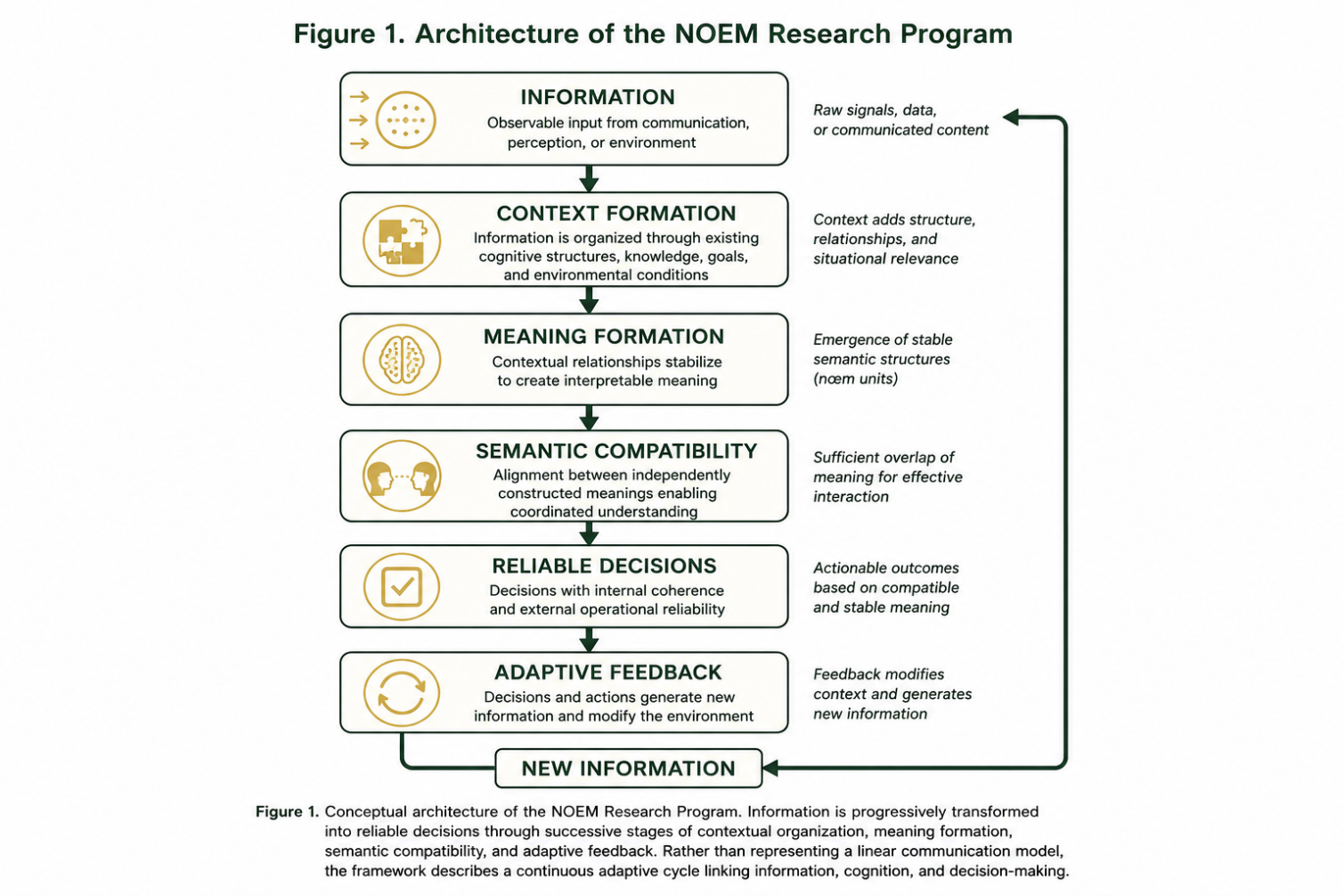
The proposed architecture consists of six sequential but continuously interacting conceptual layers.
The first layer is information.
Information represents the observable input entering a cognitive system through communication, perception, measurement, or interaction with the external environment.
Information alone, however, possesses no intrinsic operational meaning.
Its significance depends upon contextual interpretation.
The second layer is contextual organization.
At this stage, incoming information is interpreted through existing cognitive structures, prior knowledge, objectives, environmental conditions, and accumulated experience.
Context transforms isolated informational elements into coherent semantic relationships.
The third layer is meaning formation.
Meaning emerges when contextual relationships become sufficiently stable to support consistent interpretation.
Within the NOEM Framework, meaning is therefore regarded as an emergent organizational property rather than as an inherent attribute of information itself.
The fourth layer is compatibility.
Independent cognitive systems may generate different meanings from identical information.
Reliable interaction therefore requires sufficient semantic compatibility between participants.
Compatibility does not require identical understanding.
Instead, it requires sufficient overlap between independently constructed meanings to support coordinated action.
The fifth layer is decision formation.
Only after compatibility has been achieved can cognitive systems produce decisions possessing both internal coherence and external operational reliability.
Finally, the sixth layer is adaptive feedback.
Every decision modifies the surrounding informational environment, generating new information, new contexts, and new cycles of meaning formation.
Consequently, the NOEM Architecture should be understood not as a linear sequence but as a continuously evolving adaptive system.
4.2 Meaning as an Adaptive Property
One of the central propositions of the NOEM Research Program is that meaning should not be regarded as a static semantic object.
Meaning changes.
It evolves.
It stabilizes.
It degrades.
It can fragment.
It can recover.
Accordingly, meaning should be understood as an adaptive property emerging from continuous interaction between cognitive systems and their informational environments.
This perspective differs from approaches that implicitly assume stable semantic representations.
Within NOEM, stability itself becomes a dynamic variable that determines whether reliable interaction remains possible under changing conditions.
Consequently, the principal objective of intelligent systems is not merely to maximize predictive accuracy but to preserve semantic stability throughout adaptive interaction.
5. Meaning Formation
The central proposition of the NOEM Research Program is that information and meaning should not be regarded as equivalent concepts.
Information may exist independently of interpretation.
Meaning cannot.
Information represents the observable content entering a cognitive system through perception, communication, measurement, or interaction with the external environment.
Meaning emerges only after that information has been organized within a coherent cognitive context.
Consequently, meaning should not be understood as a property of information itself, but as the result of an adaptive cognitive transformation.
This distinction has profound implications for both human cognition and artificial intelligence.
Current AI systems excel at generating statistically plausible information.
However, statistical plausibility alone does not guarantee semantic stability.
Meaning requires organization.
Organization requires context.
Context requires interaction.
The NOEM Research Program therefore considers meaning formation to be the primary adaptive process through which cognitive systems transform informational uncertainty into operational understanding.
Unlike conventional communication models, the proposed framework assumes that meaning is continuously reconstructed rather than transferred.
Each interaction modifies the semantic state of both participants.
Meaning therefore evolves dynamically throughout dialogue rather than remaining fixed after transmission.
Reliable cognition depends upon preserving sufficient semantic stability throughout this continuous process.
5.1 Semantic Entropy
The transformation of information into meaning occurs under conditions of uncertainty.
Within the NOEM Research Program, this uncertainty is described as Semantic Entropy.
Unlike Shannon entropy, which measures uncertainty in symbol distributions, Semantic Entropy characterizes uncertainty in interpretation.
A message may possess low informational entropy while simultaneously exhibiting high semantic entropy if multiple incompatible interpretations remain possible.
Conversely, relatively complex informational structures may produce very low semantic entropy when contextual constraints stabilize interpretation.
Semantic Entropy therefore represents the uncertainty of meaning rather than the uncertainty of information.
From this perspective, cognition becomes a continuous process of semantic entropy reduction.
Each successful interpretative step decreases the number of plausible semantic alternatives and increases the stability of understanding.
Meaning formation may therefore be viewed as an adaptive trajectory from semantic uncertainty toward semantic stability.
Definition 2. Semantic Entropy
Semantic Entropy is the degree of uncertainty associated with the interpretation of information within a cognitive system. It reflects the number, diversity, and instability of plausible meanings that remain available before semantic stabilization occurs.
Unlike informational entropy, Semantic Entropy is context-dependent and continuously evolves throughout cognitive interaction.
5.2 The ψ-Operator
If semantic entropy describes the state of uncertainty, a complementary mechanism is required to explain how uncertainty becomes stable meaning.
The NOEM Research Program introduces the ψ-operator as the conceptual mechanism responsible for this transformation.
The ψ-operator does not represent a computational algorithm or a mathematical function in the conventional sense.
Rather, it describes the adaptive cognitive process through which information, contextual knowledge, attention, intention, prior experience, and environmental constraints become integrated into coherent semantic structures.
Within this framework, cognition is interpreted as a sequence of ψ-transformations.
Each transformation progressively reduces semantic entropy while simultaneously increasing semantic organization.
The outcome of this process is not merely additional information but a qualitatively different cognitive state characterized by stable understanding.
Importantly, ψ-transformations remain fundamentally interactive.
Meaning is not created by isolated cognitive systems.
Instead, it emerges through continuous interaction among agents, contexts, objectives, and environments.
Definition 3. ψ-Operator
The ψ-operator is the conceptual mechanism through which information is transformed into stable meaning by reducing semantic entropy under conditions of contextual interaction, cognitive attention, and adaptive organization.
Rather than describing computation, the ψ-operator describes cognitive transformation.
5.3 nœm Units
The stabilization of meaning produces discrete semantic structures referred to within the NOEM Research Program as nœm units.
A nœm unit represents the smallest stable cognitive structure capable of supporting reliable interpretation.
Unlike individual words or symbols, nœm units are context-dependent semantic organizations.
Their boundaries are determined not by language but by semantic stability.
A single sentence may generate multiple nœm units.
Conversely, complex documents may ultimately stabilize around one dominant semantic structure.
This perspective suggests that meaning develops through successive stages of stabilization rather than continuous accumulation.
The emergence of nœm units therefore represents discrete transitions within adaptive cognition.
Definition 4. nœm Unit
A nœm unit is the minimal stable semantic structure produced through ψ-transformation after semantic entropy has been sufficiently reduced to support reliable interpretation and subsequent decision-making.
Within the NOEM Research Program, nœm units constitute the fundamental building blocks of meaningful cognition.
Editorial Transition
If meaning emerges through ψ-transformations and stabilizes as nœm units, an equally important question follows.
How can independently formed meanings remain sufficiently aligned to support cooperation between different cognitive systems?
This question leads directly to the next chapter:
6. Human–AI Compatibility
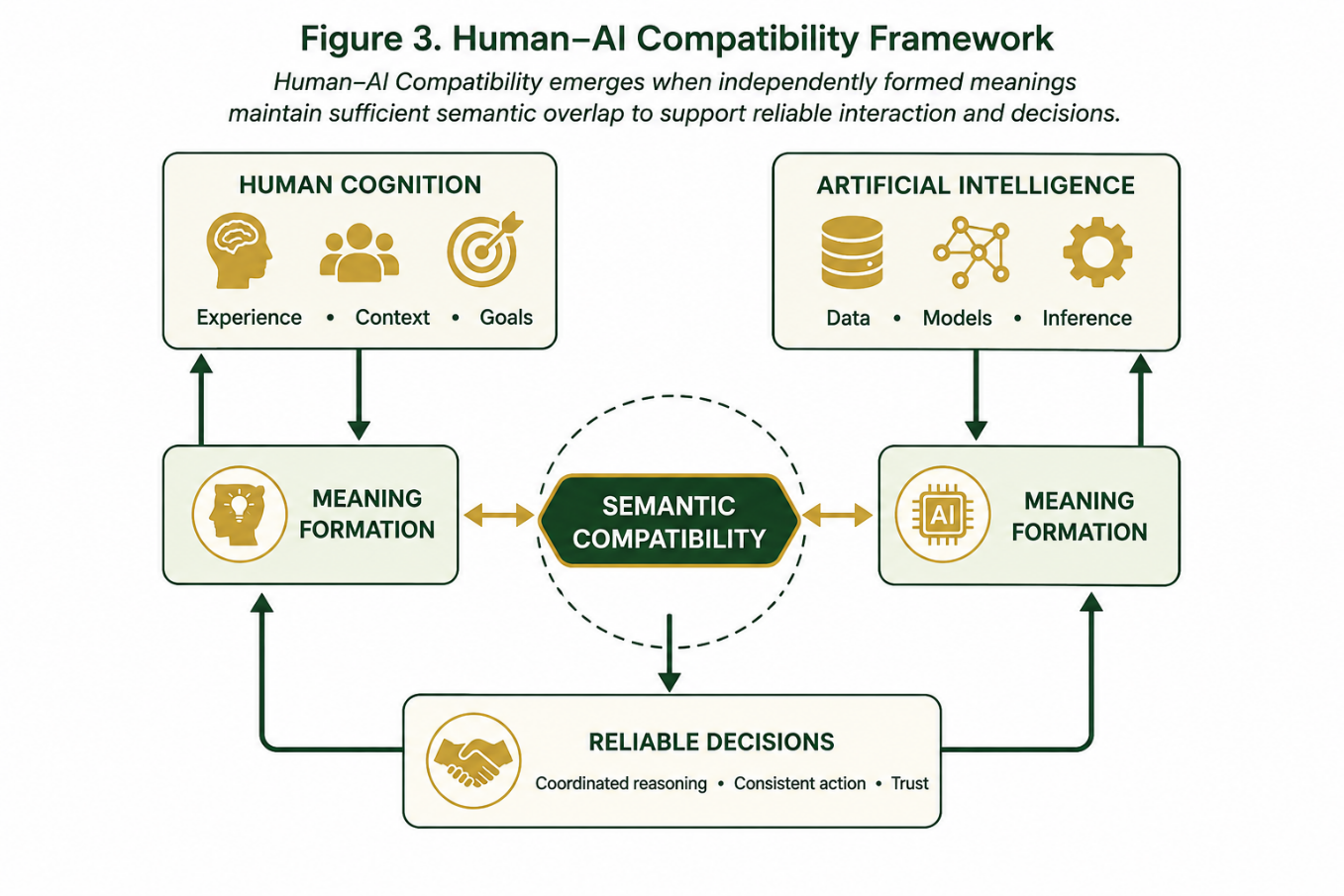
Reliable interaction between cognitive systems depends not only on the quality of internally constructed meaning but also on the degree to which independently formed meanings remain mutually compatible.
Within the NOEM Research Program, this property is referred to as Human–AI Compatibility.
Compatibility should not be interpreted as agreement.
Nor does it imply identical reasoning processes or identical internal representations.
Instead, compatibility describes the ability of different cognitive systems to maintain sufficient semantic overlap to support reliable communication, coordinated action, and consistent decision-making despite differences in architecture, knowledge, experience, or learning mechanisms.
Human cognition and artificial intelligence process information in fundamentally different ways.
Humans rely upon embodied experience, intuition, cultural knowledge, emotional context, and long-term personal memory.
Artificial intelligence relies primarily upon statistical associations, learned representations, and computational inference.
Despite these differences, both systems may successfully cooperate if the meanings independently constructed during interaction remain sufficiently compatible.
Consequently, compatibility represents an emergent relational property rather than an intrinsic characteristic of either participant.
It exists only within interaction.
6.1 Compatibility Is Not Similarity
One of the central assumptions of the NOEM Research Program is that compatibility should not be confused with similarity.
Two cognitive systems may employ entirely different internal reasoning mechanisms while nevertheless reaching highly compatible semantic interpretations.
Conversely, systems built upon nearly identical computational architectures may produce incompatible meanings when contextual assumptions differ.
Compatibility therefore depends upon the stability of semantic relationships rather than structural similarity.
This distinction has important implications for the future development of artificial intelligence.
Improving model architecture alone cannot guarantee improved Human–AI interaction.
Instead, progress increasingly depends upon preserving semantic compatibility throughout adaptive dialogue.
The primary objective shifts from constructing more intelligent systems toward constructing systems capable of maintaining compatible understanding under changing informational conditions.
Definition 5. Human–AI Compatibility
Human–AI Compatibility is the degree to which independently constructed meanings remain sufficiently aligned to enable reliable communication, coordinated reasoning, and consistent decision-making between human and artificial cognitive systems.
Compatibility is therefore an emergent property of interaction rather than an attribute of individual intelligence.
6.2 Compatibility Engineering
If compatibility determines the quality of Human–AI interaction, then compatibility itself becomes an object of scientific design.
The NOEM Research Program therefore introduces the concept of Compatibility Engineering.
Compatibility Engineering is not concerned primarily with optimizing model parameters or increasing computational performance.
Instead, it focuses on designing interactions that preserve semantic stability throughout the complete cognitive cycle.
This includes the formulation of questions, contextual organization of information, semantic monitoring during dialogue, identification of emerging misunderstandings, adaptive clarification, and continuous evaluation of shared meaning.
Within this perspective, prompts become only one component of a much broader compatibility architecture.
Reliable interaction increasingly depends upon the design of semantic processes rather than isolated prompt formulations.
Compatibility Engineering therefore represents a transition from prompt optimization toward systematic cognitive interaction design.
Definition 6. Compatibility Engineering
Compatibility Engineering is the systematic design, evaluation, and optimization of cognitive interactions to preserve semantic stability and maintain reliable meaning formation between human and artificial intelligence throughout adaptive decision-making processes.
6.3 Measuring Compatibility
A scientific theory becomes substantially stronger when it defines not only concepts but also the possibility of their empirical evaluation.
Although the NOEM Research Program is primarily conceptual, it assumes that Human–AI Compatibility can ultimately be assessed through observable indicators.
Potential dimensions include:
semantic consistency across repeated interactions;
contextual stability during extended dialogue;
preservation of intended meaning;
convergence of independently generated interpretations;
robustness under informational perturbations;
decision consistency over time.
Future empirical research may integrate these dimensions into composite compatibility metrics suitable for experimental validation across different AI systems, institutional environments, and collaborative decision-making scenarios.
The objective is not to measure intelligence itself, but to evaluate the reliability of shared meaning generated during interaction.
Figure 3. Human–AI Compatibility Framework
Editorial Transition
Compatibility alone, however, does not guarantee successful outcomes.
Even perfectly compatible cognitive systems may produce poor decisions if the surrounding informational environment becomes excessively complex or semantically unstable.
Reliable decision-making therefore depends upon the interaction between meaning formation, compatibility, and the informational conditions within which cognition occurs.
The following section integrates these elements into a unified model of Decision Reliability.
7. Decision Reliability
Reliable decisions do not emerge directly from intelligence, information, or computational performance alone.
Within the NOEM Research Program, decision reliability is understood as the cumulative outcome of the entire cognitive process.
Information must first be interpreted.
Interpretation must become stable meaning.
Meaning must remain sufficiently compatible between interacting cognitive systems.
Only then can a decision achieve both internal coherence and operational reliability.
Consequently, reliable decisions should be regarded as emergent properties of successful cognitive interaction rather than products of isolated reasoning.
This distinction is fundamental.
Traditional decision models often evaluate decisions according to their outcomes.
The NOEM Research Program instead evaluates the integrity of the process through which those outcomes are generated.
Reliable outcomes cannot be consistently expected from unreliable meaning formation.
Likewise, sophisticated computational reasoning cannot compensate for unstable semantic foundations.
Decision reliability therefore depends upon preserving semantic stability throughout every stage of cognitive interaction.
7.1 Decision Reliability as an Emergent Property
The proposed framework assumes that no individual component of cognition is independently sufficient to guarantee reliable decisions.
Information may be complete while meaning remains ambiguous.
Meaning may be internally coherent while compatibility remains insufficient.
Compatibility may exist while the informational environment continues to evolve faster than adaptive learning.
Reliable decisions therefore emerge only when multiple cognitive conditions remain simultaneously satisfied.
This perspective differs from conventional optimization approaches that attempt to maximize individual variables independently.
Instead, the NOEM Research Program proposes that reliability is a systemic property arising from balanced interaction among information, meaning, compatibility, and adaptive feedback.
Reliability therefore belongs to the cognitive ecosystem rather than to any individual participant.
Definition 7. Decision Reliability
Decision Reliability is the degree to which a decision consistently preserves semantic coherence, contextual validity, adaptive compatibility, and operational effectiveness throughout the complete cognitive interaction process.
Reliable decisions therefore represent properties of stable cognitive ecosystems rather than isolated acts of reasoning.
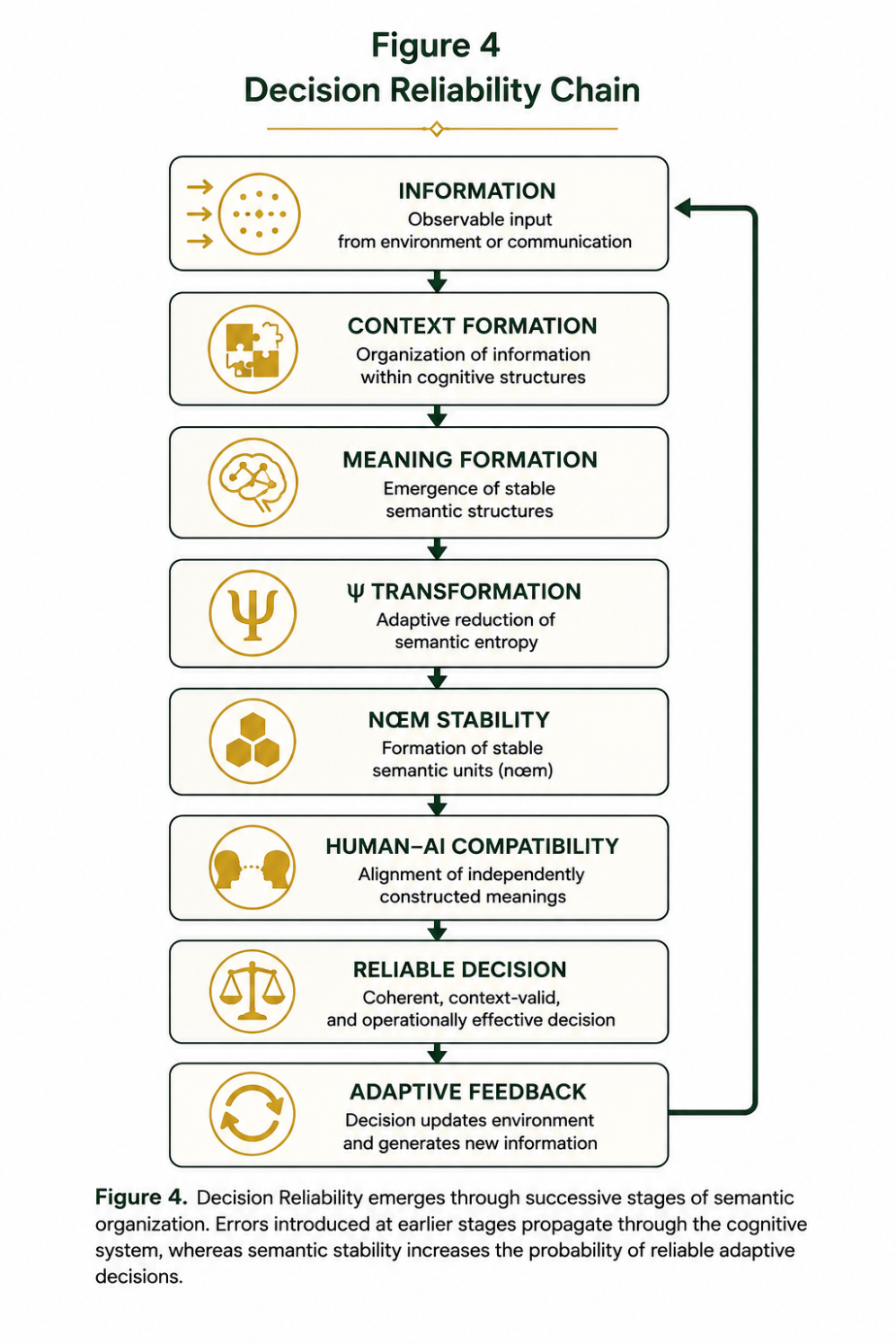
7.2 The Reliability Chain
Within the NOEM Research Program, reliable decisions emerge through a sequential dependency chain.
Each stage depends upon the successful completion of the preceding stage.
Information provides the initial cognitive input.
Meaning organizes information into interpretable semantic structures.
Compatibility aligns independently constructed meanings across interacting cognitive systems.
Reliable decisions become possible only after these previous stages have achieved sufficient stability.
Failure occurring at any earlier stage propagates throughout the remaining decision process.
Consequently, decision errors frequently originate long before final reasoning begins.
Many incorrect decisions therefore reflect failures of semantic organization rather than failures of intelligence itself.
This observation represents one of the central theoretical implications of the NOEM Research Program.
Figure 4
Decision Reliability Chain
7.3 The Reliability Principle
The NOEM Research Program leads to a general principle governing adaptive cognition.
The probability of a reliable decision is limited by the least stable stage of the meaning formation process.
Increasing computational capability cannot compensate indefinitely for semantic instability introduced during earlier stages of cognitive interaction.
Likewise, improving semantic compatibility cannot fully correct decisions constructed upon incomplete or misleading information.
Decision reliability therefore depends upon preserving stability throughout the entire cognitive architecture.
The practical implication is significant.
Future intelligent systems should optimize not individual computational components but the integrity of the complete semantic process.
Reliability thus becomes an architectural objective rather than a computational objective.
Definition 8. Reliability Principle
The Reliability Principle states that the probability of obtaining a reliable decision is constrained by the lowest level of semantic stability present within the complete cognitive interaction process.
In other words, a decision can never become more reliable than the meaning upon which it is built.
8. Meaning Artificial Intelligence (MAI)
The concepts developed throughout the NOEM Research Program naturally suggest a broader perspective on the future evolution of artificial intelligence.
Contemporary AI systems primarily optimize prediction.
Large language models estimate the statistical probability of subsequent linguistic elements, producing responses that often appear coherent, informative, and contextually appropriate.
This paradigm has achieved extraordinary practical success.
Nevertheless, the preceding analysis suggests that prediction alone cannot fully explain reliable cognition.
Reliable decisions require stable meaning.
Meaning requires semantic organization.
Semantic organization requires compatibility.
Consequently, future artificial intelligence may evolve beyond purely predictive architectures toward systems explicitly designed to preserve semantic stability during interaction.
The NOEM Research Program refers to this emerging paradigm as Meaning Artificial Intelligence (MAI).
MAI does not replace contemporary artificial intelligence.
Rather, it represents its conceptual extension.
Where conventional AI primarily answers questions, MAI continuously evaluates whether shared meaning has actually been established.
The objective therefore shifts from maximizing response quality toward maximizing decision reliability.
Within this perspective, intelligence is measured not only by computational performance but also by the ability to preserve semantic coherence throughout extended cognitive interaction.
8.1 From Prompt Engineering to Compatibility Engineering
The rapid adoption of generative AI has stimulated intensive interest in prompt engineering.
Carefully designed prompts frequently improve response quality by providing clearer instructions and richer contextual information.
However, prompt optimization addresses only the initial stage of interaction.
The NOEM Research Program argues that reliable Human–AI collaboration depends upon the entire semantic process rather than upon prompts alone.
Consequently, future intelligent systems should increasingly support continuous semantic monitoring throughout dialogue.
Compatibility should be evaluated dynamically.
Emerging misunderstandings should be detected before they influence subsequent reasoning.
Semantic drift should become observable rather than remaining hidden.
Interaction should therefore become adaptive rather than static.
This broader perspective transforms prompt engineering into Compatibility Engineering—the systematic design of interactions that preserve shared meaning over time.
8.2 MAI as an Adaptive Cognitive Architecture
Meaning Artificial Intelligence is therefore conceived as an adaptive cognitive architecture rather than a particular computational model.
Its defining characteristic is the continuous regulation of semantic stability throughout interaction.
Within this architecture, every stage of cognition contributes to the reliability of subsequent decisions.
Information enters the system.
Context organizes interpretation.
Meaning emerges through ψ-transformations.
Stable semantic structures develop as nœm units.
Compatibility is continuously evaluated.
Reliable decisions become possible.
Adaptive feedback updates future interaction.
The resulting architecture is recursive.
Each completed cognitive cycle improves the quality of subsequent meaning formation.
Artificial intelligence therefore becomes an active participant in a continuously evolving semantic ecosystem.
Definition 9. Meaning Artificial Intelligence
Meaning Artificial Intelligence (MAI) is an adaptive cognitive architecture designed to preserve semantic stability, maintain compatibility between interacting cognitive systems, and support reliable decision-making through continuous meaning formation rather than prediction alone.
Unlike conventional artificial intelligence, MAI evaluates the quality of cognitive interaction itself.
8.3 Toward Meaning-Centered AI
The transition toward Meaning Artificial Intelligence represents more than a technological evolution.
It reflects a broader conceptual transformation.
Throughout much of the history of computing, intelligence has been interpreted primarily as computational capability.
The NOEM Research Program proposes an alternative perspective.
Intelligence should increasingly be evaluated according to its capacity to construct, preserve, communicate, and adapt shared meaning within continuously changing informational environments.
Within this perspective, computational performance remains essential.
Yet computational performance alone becomes insufficient.
The future development of artificial intelligence therefore depends not only upon larger models, faster processors, or greater quantities of data.
It depends equally upon developing systems capable of sustaining semantic stability throughout adaptive interaction with humans and with other intelligent agents.
Meaning thus becomes not a consequence of intelligence.
Meaning becomes one of its defining objectives.
Editorial Transition
If Meaning Artificial Intelligence represents a future direction for intelligent systems, an important practical question immediately follows.
How can the concepts introduced throughout the NOEM Research Program contribute to scientific research, institutional governance, organizational decision-making, education, and industrial practice?
The following section addresses these practical implications.
9. Practical Implications
The NOEM Research Program is intended not merely as a theoretical contribution but as a conceptual foundation for improving decision reliability across diverse domains characterized by increasing informational complexity.
Although developed within the context of Human–AI interaction, the proposed framework is sufficiently general to support applications wherever multiple cognitive systems must cooperate under conditions of uncertainty, continuous change, and growing information density.
Rather than replacing existing decision-support methods, the framework complements them by introducing meaning formation and semantic compatibility as additional dimensions of decision quality.
Artificial Intelligence
For artificial intelligence research, the NOEM Framework suggests a gradual transition from optimizing predictive performance toward optimizing semantic stability throughout interaction.
Future AI systems may increasingly evaluate not only the correctness of generated responses but also the degree to which shared meaning has been established and preserved during dialogue.
Decision Intelligence
Within organizational decision support, the framework provides a conceptual basis for evaluating the reliability of reasoning processes rather than merely assessing final outcomes.
Decision quality becomes a property of the complete cognitive architecture linking information, context, meaning, compatibility, and adaptive feedback.
Institutional Governance
Governments and public institutions increasingly operate under conditions of rapidly growing Information Density.
The NOEM Framework offers a common language for understanding why institutional adaptation depends not only on regulatory capacity but also on the preservation of semantic coherence across complex organizational environments.
Education
Educational systems may benefit from shifting emphasis from information transmission toward meaning formation.
Learning becomes the progressive stabilization of meaningful cognitive structures rather than the accumulation of isolated knowledge.
This perspective aligns naturally with interdisciplinary education, systems thinking, and lifelong learning.
Scientific Research
The framework also provides researchers with a conceptual architecture capable of integrating ideas originating from information theory, cognitive science, economics, institutional analysis, artificial intelligence, and decision theory.
Future interdisciplinary research may therefore employ the NOEM Framework as a common theoretical language rather than as a domain-specific model.
10. Future Research
The NOEM Research Program establishes a conceptual foundation whose empirical development remains an important direction for future investigation.
Several research priorities naturally emerge.
The first concerns the development of quantitative methods for evaluating semantic stability, compatibility, and decision reliability across different cognitive environments.
The second involves experimental validation of the proposed concepts through controlled Human–AI interaction studies, comparative analyses of decision quality, and longitudinal observations of adaptive learning.
A third direction concerns the formalization of the ψ-operator and the operational measurement of nœm units within computational cognitive systems.
Further research may investigate how Information Density influences compatibility, how semantic entropy evolves during extended interaction, and how adaptive feedback contributes to long-term improvements in decision reliability.
Finally, the NOEM Framework provides a theoretical basis for the future development of Meaning Artificial Intelligence, digital cognitive twins, adaptive multi-agent systems, and institutional decision diagnostics.
These directions collectively define a long-term interdisciplinary research agenda extending beyond the present conceptual study.
11. Conclusion
Artificial intelligence has transformed humanity's ability to generate information.
The next scientific challenge is understanding how information becomes reliable meaning.
The NOEM Research Program proposes that decision reliability cannot be explained solely by computational capability, predictive accuracy, or information processing.
Reliable decisions emerge through a broader adaptive process in which information is organized by context, transformed into stable meaning, aligned through semantic compatibility, and continuously refined by adaptive feedback.
Within this perspective, meaning becomes the central organizing principle connecting information, cognition, and action.
The framework introduced in this article integrates Information Density, Semantic Compression, Question Competence, the ψ-operator, nœm units, Human–AI Compatibility, and Meaning Artificial Intelligence into a unified conceptual architecture.
Together these concepts provide a common theoretical language for analyzing reliable cognition across human, organizational, and artificial intelligence systems.
Although conceptual in its present form, the NOEM Research Program establishes a coherent foundation for future empirical investigation, computational implementation, and interdisciplinary collaboration.
Its objective is not to replace existing theories but to connect them within a broader framework centered on meaning formation and adaptive cognition.
As digital ecosystems become increasingly interconnected, the reliability of future decisions will depend less on computational power alone than on the capacity of intelligent systems to construct, preserve, and continuously share stable meaning.
The central challenge of the coming decade is no longer artificial intelligence itself. It is the science of reliable meaning.
Acknowledgements
The author gratefully acknowledges the use of artificial intelligence as a collaborative research assistant during the preparation of this manuscript. AI tools supported language refinement, structural editing, conceptual discussion, and visualization design. All theoretical concepts, definitions, interpretations, and conclusions remain the sole responsibility of the author.
Funding
This research received no external funding.
Conflict of Interest
The author declares no conflict of interest.
AI-Assisted Research Disclosure
Artificial intelligence tools were used to assist with language editing, structural refinement, visualization design, and editorial review. AI did not generate the theoretical concepts or scientific conclusions presented in this article. Responsibility for the content remains entirely with the author.
References
Acemoglu, D., & Johnson, S. (2023). Power and progress: Our thousand-year struggle over technology and prosperity. PublicAffairs.
Ashby, W. R. (1956). An introduction to cybernetics. Chapman & Hall.
Bar-Yam, Y. (1997). Dynamics of complex systems. Addison-Wesley.
Beer, S. (1972). Brain of the firm (2nd ed.). Allen Lane.
Bender, E. M., Gebru, T., McMillan-Major, A., & Shmitchell, S. (2021). On the dangers of stochastic parrots: Can language models be too big? 🦜 Proceedings of the 2021 ACM Conference on Fairness, Accountability, and Transparency, 610–623.
Brown, T. B., Mann, B., Ryder, N., et al. (2020). Language models are few-shot learners. Advances in Neural Information Processing Systems, 33, 1877–1901.
Bykovski, A. (2025). The search function of capital: Why some investment bubbles build the future. SSRN.
Bykovski, A. (2025). The myth of secret commands: Semantic compression, cognitive compatibility, and meaning drift in Human–AI systems. SSRN.
Bykovski, A. (2025). Question competence: A conceptual framework for reliable Human–AI interaction. SSRN.
Bykovski, A. (2026). Information density: A new perspective on institutional adaptation in complex information environments. SSRN.
Bykovski, A. (2026). The Bykovski paradox: Structural regularity, linguistic entropy, and the limits of AI detection. SSRN.
Bykovski, A. (2026). Human–AI compatibility: Toward compatibility engineering and reliable cognitive interaction. SSRN.
Castells, M. (2010). The rise of the network society (2nd ed.). Wiley-Blackwell.
Clark, A. (1997). Being there: Putting brain, body, and world together again. MIT Press.
Floridi, L. (2014). The fourth revolution: How the infosphere is reshaping human reality. Oxford University Press.
Friston, K. (2010). The free-energy principle: A unified brain theory? Nature Reviews Neuroscience, 11(2), 127–138.
Gigerenzer, G. (2007). Gut feelings: The intelligence of the unconscious. Viking.
Grice, H. P. (1989). Studies in the way of words. Harvard University Press.
Haken, H. (1983). Synergetics: An introduction (3rd ed.). Springer.
Hayek, F. A. (1945). The use of knowledge in society. American Economic Review, 35(4), 519–530.
Kahneman, D. (2011). Thinking, fast and slow. Farrar, Straus and Giroux.
Landauer, R. (1991). Information is physical. Physics Today, 44(5), 23–29.
Meadows, D. H. (2008). Thinking in systems: A primer. Chelsea Green Publishing.
North, D. C. (1990). Institutions, institutional change and economic performance. Cambridge University Press.
Peirce, C. S. (1998). The essential Peirce: Selected philosophical writings (Vol. 2). Indiana University Press. (Original works published 1893–1913)
Russell, S., & Norvig, P. (2021). Artificial intelligence: A modern approach (4th ed.). Pearson.
Saussure, F. de. (2011). Course in general linguistics. Columbia University Press. (Original work published 1916)
Shannon, C. E. (1948). A mathematical theory of communication. Bell System Technical Journal, 27(3), 379–423, 623–656.
Shannon, C. E., & Weaver, W. (1949). The mathematical theory of communication. University of Illinois Press.
Simon, H. A. (1947). Administrative behavior. Macmillan.
Simon, H. A. (1969). The sciences of the artificial. MIT Press.
Sperber, D., & Wilson, D. (1995). Relevance: Communication and cognition (2nd ed.). Blackwell.
Vaswani, A., Shazeer, N., Parmar, N., et al. (2017). Attention is all you need. Advances in Neural Information Processing Systems, 30.
Weick, K. E. (1995). Sensemaking in organizations. Sage Publications.
Wiener, N. (1948). Cybernetics: Or control and communication in the animal and the machine. MIT Press.
Wittgenstein, L. (1953). Philosophical investigations. Blackwell.
Zuboff, S. (2019). The age of surveillance capitalism. PublicAffairs.
EX-JICS