The Search Function of Capital
Why Some Investment Bubbles Build the Future — Research Article, Vol. 1 No. 1
Volume 1 • Issue 1 • June 2026
The Search Function of Capital:
Why Some Investment Bubbles Build the Future
Alexander Bykovski, EnergeticaX Institute
Correspondence: journal@energeticax.org
Article Information
| Item | Information |
|---|---|
| Article Type | Research Article |
| Received | June 2026 |
| Revised | — |
| Accepted | June 2026 |
| Published | June 2026 |
| DOI | To be assigned |
| License | CC BY 4.0 |
Abstract
Investment bubbles are traditionally interpreted as episodes of irrational speculation, capital misallocation, and financial instability. While such interpretations explain the immediate economic consequences of speculative cycles, they often overlook their long-term contribution to technological development. This article proposes the concept of the search function of capital, arguing that during periods of profound technological uncertainty capital performs not only its conventional allocative role but also an exploratory function. Rather than financing a single predictable future, investment is distributed across multiple competing technological pathways, enabling societies to discover new productive opportunities that cannot be identified through conventional market analysis alone. Historical examples—including railway expansion, electrification, the Internet revolution, and the current wave of artificial intelligence investment—illustrate that although speculative corrections frequently destroy financial wealth, they may simultaneously leave behind infrastructure, technological capabilities, and institutional knowledge that become foundations for future economic growth. The article further distinguishes between bubbles that merely inflate asset prices and those that create durable productive capacity. This perspective contributes to innovation economics by proposing a broader interpretation of capital formation under radical uncertainty and offers a framework for evaluating contemporary investment cycles beyond short-term market performance.
Highlights
Introduces the concept of the search function of capital as a complementary role of investment under technological uncertainty.
Distinguishes between speculative bubbles that destroy wealth and those that create long-term productive infrastructure.
Provides a new interpretation of contemporary AI investment through historical comparison.
Research Context
This article contributes to the growing literature on innovation economics by proposing that capital performs not only an allocative function but also a search function during periods of profound technological uncertainty. The proposed interpretation connects historical technological revolutions with contemporary investment dynamics in artificial intelligence and infrastructure development, offering an alternative perspective on the economic role of speculative investment.
Keywords
Investment Bubbles; Capital Allocation; Search Function of Capital; Innovation Economics; Artificial Intelligence; Technological Change; Infrastructure Investment; Decision Intelligence.
Introduction
Every generation believes it has finally learned how to recognize an investment bubble.
Yet every generation is surprised when the next technological revolution arrives wrapped inside one.
The railway boom of the nineteenth century, the electrification wave of the early twentieth century, the dot-com era of the late 1990s, and today's artificial-intelligence investment surge all followed a remarkably similar pattern: excessive optimism, massive capital concentration, financial correction, and long-term technological transformation.
This recurring pattern raises an uncomfortable question.
What if investment bubbles are not merely market failures?
What if, under certain conditions, they perform an adaptive function?
Traditional economic analysis tends to focus on the destructive side of bubbles. When valuations collapse, investors lose money, companies fail, and commentators point to irrational exuberance, poor judgment, and misallocation of resources.
These criticisms are often justified.
But they capture only part of the story.
Consider the railway mania that swept Britain during the nineteenth century. Many investors suffered substantial losses. Numerous railway companies failed to deliver the returns that had been promised. Yet the tracks remained. The infrastructure built during the boom transformed transportation, reduced economic frictions, integrated markets, and accelerated industrial development for decades.
A similar pattern emerged during the electrification era. Financial speculation frequently ran ahead of commercial reality. Investors often overestimated short-term profitability. Yet the power grids constructed during this period became one of the foundational infrastructures of modern civilization.
The internet boom followed the same trajectory. The collapse of the dot-com bubble erased trillions of dollars in market value and destroyed hundreds of companies. Nevertheless, the fiber-optic networks, data infrastructure, and digital capabilities created during the boom survived. They became the foundation of today's digital economy.
In each case, investors lost wealth, but society gained infrastructure.
This suggests that something more complex is occurring than simple speculative excess.
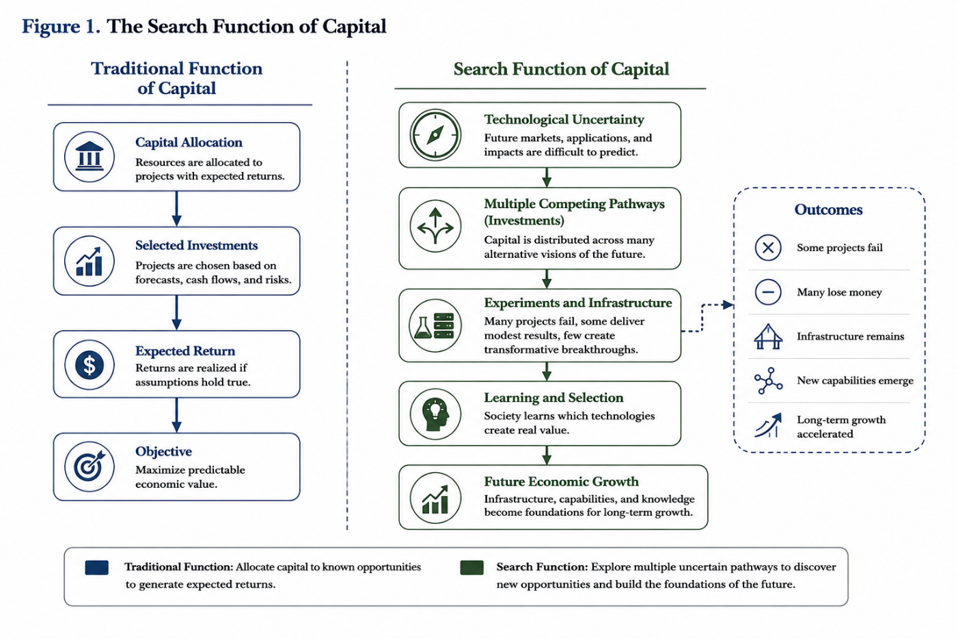
Under normal conditions, capital performs an investment function. Resources are allocated to projects that appear capable of generating future returns. Decisions are based on forecasts, expected cash flows, and measurable risks.
But transformative technologies create a different environment.
When a technology is genuinely novel, future markets are difficult to estimate. Many applications have not yet been discovered. Economic impacts remain uncertain. Traditional valuation methods become less reliable because the future itself is unclear.
Under these conditions, capital begins to perform a second function.
It becomes a mechanism for searching the future.
Rather than financing a single predictable outcome, investors fund multiple competing visions of what the future might become. Most of these visions fail. Some survive. A few reshape entire industries and redefine economic possibilities.
From this perspective, periods of intense investment may be understood not merely as episodes of speculation but as large-scale social experiments in technological exploration.
The process is often inefficient and expensive. It inevitably generates mistakes. Yet it can also accelerate the construction of capabilities that would otherwise take decades to emerge.
Importantly, not all bubbles should be viewed in the same way.
Some leave behind little more than financial losses.
Others leave behind productive assets, technological capabilities, and institutional knowledge.
The Dutch Tulip Mania of the seventeenth century is frequently cited as a classic example of speculative excess that produced little lasting economic infrastructure. Similar arguments have been made regarding the South Sea Bubble and certain phases of later asset-price booms that generated substantial financial activity without creating significant productive capacity.
By contrast, railway investment booms left transportation networks. Electrification left power systems. The internet boom left digital infrastructure.
The distinction is not the scale of speculation.
Nearly all bubbles involve excessive optimism.
The distinction is what remains after the correction.
Some bubbles destroy wealth and leave little behind.
Others destroy wealth while simultaneously creating the foundations of future growth.
This distinction may be especially relevant today as governments, investors, and corporations debate the future of artificial intelligence.
Much of the current discussion focuses on valuations. Are AI companies overvalued? Is investment outpacing commercial demand? Will a correction occur?
History suggests that these questions, while important, may not be the most important ones.
The more significant question concerns what the current investment cycle is building.
The AI boom is not only financing software applications. It is funding data centers, semiconductor manufacturing, cloud infrastructure, advanced computing systems, and new platforms for scientific research, education, engineering, and decision-making.
Whether current valuations prove justified remains uncertain.
But if this investment wave leaves behind a global computational infrastructure capable of supporting future innovation, historians may ultimately judge the period differently from contemporary investors.
This does not mean that policymakers should ignore financial risks or encourage speculative behavior.
The challenge is not to celebrate every bubble.
The challenge is to distinguish between bubbles that merely inflate asset prices and bubbles that accelerate the creation of future productive capacity.
Public policy should focus not only on preventing financial excess, but also on understanding how societies mobilize resources during periods of profound technological uncertainty.
Markets frequently fail to value the future correctly.
Yet they have an extraordinary record of helping to build it.
Practical Implications
The proposed interpretation may assist policymakers, institutional investors, innovation agencies, and infrastructure planners in distinguishing between speculative investment cycles that merely inflate financial assets and those that accelerate long-term technological development.
Recognizing the search function of capital may improve strategic decision-making under conditions of radical technological uncertainty, particularly in emerging sectors such as artificial intelligence, advanced computing, clean energy, and digital infrastructure.
The proposed framework may also support long-term strategic investment evaluation within sovereign wealth funds and national innovation policies.
Future Research
Future research may focus on developing quantitative indicators capable of distinguishing productive investment bubbles from purely speculative episodes.
Comparative historical analysis, empirical testing, and application of the proposed framework to energy transition, artificial intelligence, and other emerging technologies may further clarify the conditions under which capital performs a genuine search function.
The proposed concept may also be integrated with broader theories of technological evolution, innovation systems, and decision intelligence.
Funding
No external funding was received for this research.
Conflicts of Interest
The author declares no conflict of interest.
Data Availability Statement
No new datasets were generated or analyzed during this study.
Artificial Intelligence Disclosure
Artificial intelligence tools were used to support language refinement, editorial structuring, and manuscript preparation. The scientific concepts, theoretical framework, interpretation, and conclusions presented in this article remain entirely the responsibility of the author.
References
Schumpeter, J. A. (1934). The theory of economic development. Harvard University Press.
Schumpeter, J. A. (1942). Capitalism, socialism and democracy. Harper & Brothers.
Perez, C. (2002). Technological revolutions and financial capital: The dynamics of bubbles and golden ages. Edward Elgar Publishing.
Minsky, H. P. (1986). Stabilizing an unstable economy. Yale University Press.
Kindleberger, C. P., & Aliber, R. Z. (2011). Manias, panics, and crashes: A history of financial crises (6th ed.). Palgrave Macmillan.
Shiller, R. J. (2015). Irrational exuberance (3rd ed.). Princeton University Press.
Arthur, W. B. (2009). The nature of technology: What it is and how it evolves. Free Press.
Mazzucato, M. (2013). The entrepreneurial state: Debunking public vs. private sector myths. Anthem Press.
Acemoglu, D., & Johnson, S. (2023). Power and progress: Our thousand-year struggle over technology and prosperity. PublicAffairs.
Brynjolfsson, E., & McAfee, A. (2014). The second machine age: Work, progress, and prosperity in a time of brilliant technologies. W. W. Norton & Company.
Nelson, R. R., & Winter, S. G. (1982). An evolutionary theory of economic change. Harvard University Press.
Romer, P. M. (1990). Endogenous technological change. Journal of Political Economy, 98(5), S71–S102.
Lundvall, B.-Å. (Ed.). (1992). National systems of innovation: Towards a theory of innovation and interactive learning. Pinter Publishers.
North, D. C. (1990). Institutions, institutional change and economic performance. Cambridge University Press.
Bykovski, A. (2025). Information density as a criterion for reliable decision-making in human–AI systems. SSRN.
Bykovski, A. (2025). The NOEM framework: Toward a quantitative theory of meaning formation. SSRN.
EX-JICS