The Myth of Secret Commands
Semantic Compression, Cognitive Compatibility, and Meaning Drift in Human–AI Systems — Research Article, Vol. 1 No. 1
Volume 1 • Issue 1 • June 2026
The Myth of Secret Commands:
Semantic Compression, Cognitive Compatibility, and Meaning Drift in Human–AI Systems
Alexander Bykovski, EnergeticaX Institute
Correspondence: journal@energeticax.org
Article Information
| Item | Information |
|---|---|
| Article Type | Research Article |
| Received | June 2026 |
| Revised | — |
| Accepted | June 2026 |
| Published | June 2026 |
| DOI | To be assigned |
| License | CC BY 4.0 |
Abstract
The rapid expansion of generative artificial intelligence has stimulated the widespread circulation of so-called secret prompts, hidden commands, and special instructions, which are frequently believed to unlock privileged capabilities within AI systems. This paper argues that such interpretations are conceptually misleading. Rather than representing concealed mechanisms of artificial intelligence control, these expressions function as forms of semantic compression whose effectiveness depends on shared context and the degree of cognitive compatibility between communicating systems.
The paper develops a conceptual framework linking semantic compression, symbolic communication, cognitive compatibility, semantic drift, and question competence. It demonstrates that compressed symbolic structures increase communication efficiency only while semantic alignment remains sufficiently stable. As semantic drift accumulates, compressed expressions progressively lose interpretive reliability, making explicit questioning the primary mechanism for restoring shared understanding.
Although developed within the context of Human–AI interaction, the proposed framework naturally extends to scientific communities, professional organizations, digital cultures, and other adaptive meaning-generating systems. The study contributes to communication theory by providing a unified explanation for the emergence, effectiveness, and limitations of compressed symbolic languages in complex cognitive environments.
Highlights
Demonstrates that so-called secret prompts represent semantic compression rather than hidden mechanisms of AI control.
Introduces a conceptual framework connecting semantic compression, cognitive compatibility, semantic drift, and question competence.
Extends the proposed framework from Human–AI interaction to broader adaptive cognitive systems and professional communication.
Research Context
This study contributes to contemporary Human–AI Interaction research by proposing a conceptual reinterpretation of so-called secret prompts through the broader framework of semantic compression and cognitive compatibility. Rather than treating such expressions as hidden technical commands, the paper explains them as natural products of efficient communication within adaptive cognitive systems. The proposed framework integrates perspectives from communication theory, cognitive science, linguistics, and artificial intelligence into a unified explanation of symbolic interaction.
Keywords
Human–AI Interaction; Semantic Compression; Cognitive Compatibility; Semantic Drift; Symbolic Communication; Meaning Formation; Question Competence; Adaptive Cognitive Systems.
1. Introduction
The emergence of large language models has produced a new form of digital folklore. Across online communities, users exchange collections of so-called secret prompts, hidden commands, and special instructions believed to unlock superior capabilities within artificial intelligence systems.
The popularity of these practices reflects a broader human tendency to search for simplified mechanisms of control in environments characterized by complexity and uncertainty. Similar patterns can be observed throughout history in the form of rituals, symbolic formulas, professional jargon, and coded communication systems.
This paper proposes an alternative interpretation. Secret commands do not derive their effectiveness from hidden access to artificial intelligence. Instead, they function as compressed semantic structures whose utility depends upon shared context and cognitive compatibility.
Understanding this distinction provides insight not only into human–AI communication but also into the broader dynamics of meaning formation within complex adaptive systems.
Semantic Compression and Symbolic Communication
Communication systems continuously seek efficiency.
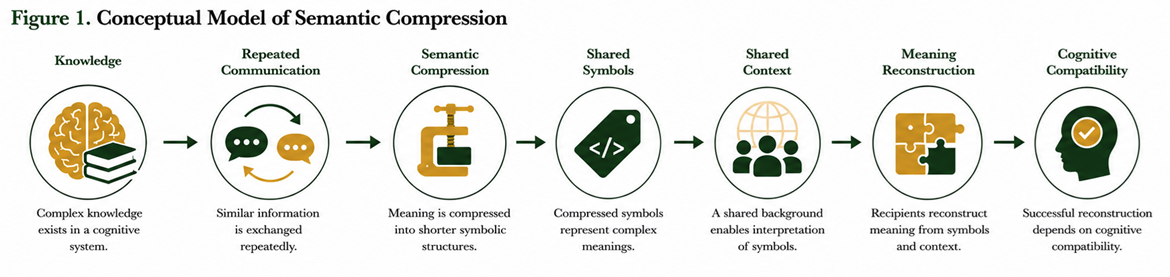
Whenever participants repeatedly exchange similar information, semantic structures become compressed into shorter symbolic forms. Technical terminology, acronyms, mathematical notation, and professional jargon all represent examples of this process.
Compression reduces communication costs but simultaneously increases dependence upon shared context. A symbol can only preserve meaning if the recipient possesses sufficient background knowledge to reconstruct the original semantic structure.
Thus, compression does not eliminate meaning; it transfers part of the interpretative burden from explicit language to shared cognitive context.
Cognitive Compatibility as a Condition for Compression
The effectiveness of semantic compression depends upon cognitive compatibility.
High levels of compatibility allow substantial compression without significant information loss. Low levels of compatibility require greater redundancy, explanation, and contextual support.
Within highly compatible systems, a short symbolic expression may communicate an extensive conceptual structure. Outside such systems, the same expression becomes ambiguous or meaningless.
The practical implication is that semantic compression is constrained by the compatibility of the interacting cognitive systems.
From Symbols to Rituals
As symbolic structures become established within communities, they often evolve into communicative rituals.
Participants may continue using symbolic expressions even after their original rationale becomes partially forgotten. The symbol gradually acquires social and identity-forming functions beyond its informational role.
This process explains the emergence of local languages, insider terminology, organizational cultures, and many forms of AI folklore.
Semantic Drift and the Limits of Compression
No symbolic system remains perfectly stable.
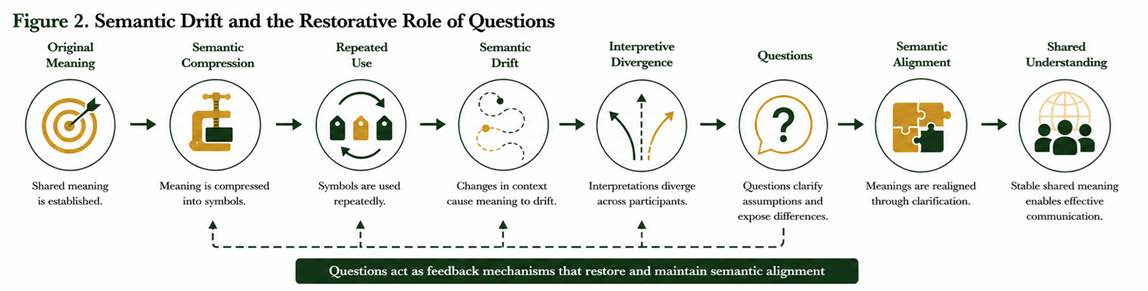
Over time, differences in interpretation accumulate. Context changes. Participants enter and leave communities. Meanings evolve.
As semantic drift increases, compressed symbols become progressively less reliable carriers of information.
The result is a paradox: the more aggressively a system compresses meaning, the more vulnerable it becomes to interpretative divergence.
Closed Cognitive Systems and the Risk of Isolation
Internal communication remains efficient, while communication with external systems becomes increasingly difficult. Such systems risk losing external corrective mechanisms and may accumulate unnoticed semantic errors.
Examples can be found in specialized professions, ideological communities, organizational cultures, and certain online groups.
Questions as Mechanisms of Semantic Correction
Questions perform a unique function within adaptive cognitive systems.
Unlike symbolic commands, questions actively test assumptions, reveal ambiguities, and restore semantic alignment between participants.
Where symbols compress meaning, questions reconstruct it.
For this reason, questioning remains one of the most important mechanisms for preserving adaptive capacity within both human and human–AI communication systems.
Conclusion
Secret commands do not represent hidden mechanisms of artificial intelligence control. They are compressed symbolic constructions whose effectiveness depends upon cognitive compatibility and shared semantic context.
As semantic drift accumulates, the informational value of compressed symbols declines. Questions therefore remain indispensable tools for maintaining semantic stability, enabling correction, and supporting adaptation in complex cognitive environments.
The search for secret commands is ultimately a search for communication efficiency. The search for better questions is a search for understanding. In adaptive cognitive systems, sustainable communication depends not on increasingly compressed symbols, but on the continuous ability to reconstruct shared meaning through questioning.
These symbolic constructions represent an early form of specialized language emerging around human–AI interaction.
Their spread demonstrates a natural tendency of cognitive systems to reduce communication costs through semantic compression.
However, the effectiveness of such symbols depends not on the symbols themselves, but on the degree of cognitive compatibility among participants and the stability of their shared semantic context.
Appendix A.
Key Concepts and Definitions
Meaning
A structured interpretation of information arising from the interaction of data, context, prior knowledge, experience, and goals within a cognitive system.
Semantic Compression
The process of reducing the explicit representation of meaning by transferring part of the interpretive burden to shared context, memory, or previously established knowledge.
Cognitive Compatibility
The degree to which different cognitive systems are capable of producing similar interpretations of the same informational signals.
High cognitive compatibility allows substantial semantic compression without significant loss of meaning.
Semantic Drift
The gradual divergence between the original and current interpretation of symbols, concepts, or messages due to contextual change, temporal distance, or differences among interpreters.
Symbol
A compact representation of a larger semantic structure.
Symbols function as carriers of compressed meaning and derive their effectiveness from shared interpretive frameworks.
Symbolic Communication
A form of communication in which meaning is transmitted primarily through symbols rather than through fully explicit descriptions.
Local Language
A system of symbols, terms, abbreviations, and interpretive conventions used by a specific group to increase the efficiency of internal communication.
Jargon
A specialized subset of language used within a professional, technical, or social community.
Jargon often emerges as a consequence of repeated semantic compression.
Ritual
A repeatedly reproduced symbolic pattern whose communicative or social function extends beyond its original informational purpose.
Shared Context
The body of assumptions, experiences, knowledge, and interpretations implicitly available to participants in a communication process.
Closed Meaning System
A cognitive system in which most processes of interpretation occur without regular external correction or validation.
Such systems may achieve high internal efficiency while becoming increasingly vulnerable to semantic isolation.
Question Competence
The ability to formulate questions that effectively reveal ambiguity, expose hidden assumptions, generate clarification, and support adaptive learning.
Question
A communicative mechanism used to identify differences in interpretation, reconstruct shared meaning, and restore semantic alignment between cognitive systems.
Cognitive Adaptability
The capacity of a cognitive system to modify its interpretive models in response to new information, feedback, or environmental change.
Human–AI Interaction
A form of communication between human and artificial cognitive systems in which meaning emerges through iterative interpretation, correction, and adaptation.
Semantic Stability
The degree to which meaning remains consistent across different contexts, participants, and time periods.
Semantic Alignment
The process through which participants in communication converge toward compatible interpretations of information.
Interpretive Reconstruction
The cognitive process by which compressed symbols are expanded into more complete semantic structures using context and prior knowledge.
Digital Folklore
Informal beliefs, narratives, myths, rituals, and symbolic practices that emerge within digital communities and spread independently of formal documentation or institutional authority.
Appendix B.
Examples of Emerging AI Community Jargon
The following examples illustrate symbolic expressions that have appeared in various AI user communities. Most of these abbreviations are not official commands and should not be interpreted as universal instructions recognized by all AI systems.
Instead, they represent elements of an emerging digital jargon and serve as practical examples of semantic compression discussed in this paper.
The meanings associated with such symbols often vary across platforms, models, and user communities.
EL10
Commonly interpreted as a request for a simplified explanation.
Possible interpretation:
Explain Like I'm 10.
Function:
Reduction of cognitive complexity.
ELI5
One of the most widely used examples of semantic compression.
Meaning:
Explain Like I'm Five.
Used to request an extremely simplified explanation of a complex topic.
IQ200
A symbolic request for deeper analytical reasoning.
Often functions as a compressed version of:
"Analyze this problem as a highly capable expert, considering hidden assumptions and complex relationships."
ID10
Used in some communities as a request for increased information density.
Possible interpretation:
"Provide maximum useful information with minimal simplification."
/meta
A request for meta-level analysis.
Typically interpreted as a request to examine:
• underlying assumptions;
• structure of the problem;
• limitations of the current approach;
• alternative interpretations.
/critic
A request for critical evaluation.
Used to identify weaknesses, contradictions, hidden risks, or logical flaws.
/devil
A compressed form of:
"Act as a devil's advocate."
Used to challenge assumptions and test the robustness of an argument.
/steelman
A request to reconstruct the strongest possible version of an argument before evaluating it.
Often used as the opposite of purely adversarial criticism.
/expand
Request for additional detail and elaboration.
/compress
Request for maximum brevity while preserving essential meaning.
/deep
Informal request for a deeper analytical response.
/fast
Request for a concise and rapid answer without extensive explanation.
/compare
Request for comparative analysis of alternatives.
/timeline
Request to present events or processes as a chronological sequence.
/socratic
Request for a Socratic dialogue mode in which questions are used to guide reasoning and discovery.
/assumptions
Request to identify hidden assumptions underlying a statement, argument, or model.
/evidence
Request for supporting evidence, data, references, or justification.
/counter
Request for counterarguments or opposing viewpoints.
/risk
Request for risk analysis and identification of failure modes.
/future
Request to explore long-term implications and future scenarios.
/systems
Request to analyze a problem from a systems-thinking perspective.
/readteam
An example of a highly localized symbolic expression whose meaning is determined entirely by conventions within a specific community.
Outside that community, the symbol may carry little or no meaning.
References
1. Arthur, W. B. (2009). The nature of technology: What it is and how it evolves. Free Press.
2. Bender, E. M., Gebru, T., McMillan-Major, A., & Shmitchell, S. (2021). On the dangers of stochastic parrots: Can language models be too big? Proceedings of the 2021 ACM Conference on Fairness, Accountability, and Transparency, 610–623.
3. Bykovski, A. (2025). Information density as a criterion for reliable decision-making in Human–AI systems. SSRN.
4. Clark, H. H. (1996). Using language. Cambridge University Press.
5. Floridi, L. (2011). The philosophy of information. Oxford University Press.
6. Grice, H. P. (1989). Studies in the way of words. Harvard University Press.
7. Hofstadter, D. R. (1979). Gödel, Escher, Bach: An eternal golden braid. Basic Books.
8. Hutchins, E. (1995). Cognition in the wild. MIT Press.
9. Lakoff, G., & Johnson, M. (1980). Metaphors we live by. University of Chicago Press.
10. Peirce, C. S. (1931–1958). Collected papers of Charles Sanders Peirce (Vols. 1–8). Harvard University Press.
11. Russell, S. (2019). Human compatible: Artificial intelligence and the problem of control. Viking.
12. Saussure, F. de. (1983). Course in general linguistics (R. Harris, Trans.). Duckworth. (Original work published 1916)
13. Shannon, C. E. (1948). A mathematical theory of communication. Bell System Technical Journal, 27(3), 379–423.
14. Shannon, C. E., & Weaver, W. (1949). The mathematical theory of communication. University of Illinois Press.
15. Sperber, D., & Wilson, D. (1995). Relevance: Communication and cognition (2nd ed.). Blackwell.
16. Tomasello, M. (2008). Origins of human communication. MIT Press.
17. Weick, K. E. (1995). Sensemaking in organizations. Sage Publications.
18. Wittgenstein, L. (1953). Philosophical investigations. Blackwell.
19. Bykovski, A. (2025). The NOEM framework: Toward a quantitative theory of meaning formation. SSRN.
20. Bykovski, A. (2025). The crisis of question competence in Human–AI interaction. SSRN.
21. Bykovski, A. (2025). The Bykovski paradox: Structural regularity, linguistic entropy, and the limits of AI detection. SSRN.
EX-JICS