Information Density
A New Perspective on Institutional Adaptation in Complex Information Environments — Research Article, Vol. 1 No. 1
Volume 1 • Issue 1 • June 2026
Information Density:
A New Perspective on Institutional Adaptation in Complex Information Environments
Alexander Bykovski, EnergeticaX Institute
Correspondence: journal@energeticax.org
Article Information
| Item | Information |
|---|---|
| Article Type | Research Article |
| Received | June 2026 |
| Revised | — |
| Accepted | June 2026 |
| Published | June 2026 |
| DOI | To be assigned |
| License | CC BY 4.0 |
Abstract
The accelerating digital transformation of modern societies has fundamentally altered the relationship between information, institutions, and decision-making. While technological systems continuously increase the volume, velocity, and interconnectedness of information flows, institutional structures often adapt at a significantly slower pace. This paper introduces Information Density as a conceptual category describing the informational complexity that cognitive, organizational, and institutional systems must process in order to maintain effective decision-making.
The proposed framework argues that institutional challenges increasingly arise not from technological limitations or governance failures alone, but from a growing imbalance between information density and institutional processing capacity. As informational complexity exceeds adaptive capabilities, institutions experience institutional lag, characterized by delayed responses, fragmented governance, and increasing systemic uncertainty.
Drawing upon information economics, institutional theory, complexity science, and decision theory, the article develops a conceptual model explaining the relationship between information density, decision complexity, institutional capacity, and adaptive governance. Illustrative examples from artificial intelligence regulation and digital labor markets demonstrate how rapidly evolving informational environments expose structural limitations within existing institutional arrangements.
The concept of Information Density offers a broader theoretical perspective on institutional adaptation and provides a foundation for future empirical research into governance, digital transformation, and decision intelligence.
Highlights
Introduces Information Density as a conceptual category for describing informational complexity within adaptive systems.
Explains institutional lag as the consequence of imbalance between information density and institutional processing capacity.
Proposes a conceptual framework applicable to AI governance, digital institutions, and decision intelligence.
Research Context
Contemporary research has extensively examined digital transformation, institutional economics, bounded rationality, and information processing. However, these perspectives typically address technological development, governance structures, or decision-making separately. This article introduces Information Density as an integrating conceptual framework that explains institutional adaptation through the interaction between informational complexity and institutional processing capacity. By connecting information economics, institutional theory, complexity science, and decision research, the paper offers a unified perspective on institutional lag within increasingly complex information environments.
Keywords
Information Density; Institutional Adaptation; Institutional Capacity; Decision Complexity; Digital Governance; Complexity Science; Artificial Intelligence; Decision Intelligence.
1. Introduction
For most of modern economic history, development was constrained primarily by shortages of physical resources, capital, energy, or labor. Information itself was relatively scarce, costly to obtain, and often unevenly distributed among economic actors. Under such conditions, institutions evolved gradually, adapting to changes that occurred over extended periods.
The digital transformation of contemporary society has fundamentally altered this historical relationship. Information is no longer the limiting resource. Instead, organizations, governments, businesses, and individuals increasingly operate within environments characterized by continuously expanding volumes of data, accelerating communication, and rapidly growing informational interdependence.
As a consequence, the principal challenge of the digital economy has shifted from information acquisition to information processing.
Existing literature has extensively examined digitalization, information economics, institutional evolution, bounded rationality, and complexity theory. Yet relatively little attention has been paid to the possibility that informational complexity itself constitutes an independent structural variable influencing institutional performance.
This paper proposes Information Density as such a variable.
Rather than viewing digital transformation solely as technological progress, the article argues that it should be understood as a continuous increase in informational density—the amount, velocity, interdependence, and decision relevance of information circulating within adaptive systems.
The central argument is straightforward.
As information density increases, institutional capacity does not necessarily expand at the same rate. Once informational demands exceed institutional processing capacity, institutions experience growing adaptation delays, increasing coordination costs, fragmented governance, and rising systemic uncertainty. These phenomena are described collectively as institutional lag.
The objective of this paper is therefore not simply to analyze digital transformation, but to introduce Information Density as a conceptual framework capable of explaining institutional adaptation across complex information environments.
2. Literature Review
The relationship between information and economic organization has occupied a central position in economics, management, institutional theory, and decision science for decades. Although researchers have approached this relationship from different perspectives, a common assumption underlies most existing theories: information influences institutional performance primarily through its availability and distribution. Considerably less attention has been devoted to the changing density of information itself as an independent structural factor affecting institutional adaptation.
One of the earliest and most influential contributions was made by Friedrich Hayek, who argued that markets function as decentralized mechanisms for processing dispersed knowledge. Economic coordination, in his view, depends not on centralized planning but on the ability of institutions to utilize information distributed among countless individuals. Hayek's insight established information as a fundamental economic resource but did not explicitly address the consequences of continuously increasing informational complexity.
Herbert Simon expanded this perspective by introducing the concept of bounded rationality. Decision makers cannot process unlimited amounts of information; instead, they operate under cognitive constraints that force them to simplify reality. Simon's work shifted attention from information availability to information processing, providing an important foundation for understanding institutional limitations in increasingly complex environments.
Institutional economists, particularly Douglass North, emphasized that institutions evolve gradually through formal and informal rules that reduce uncertainty and facilitate coordination. Institutional change, however, is inherently slower than technological change because it requires political negotiation, organizational learning, legal adjustment, and social acceptance. This temporal asymmetry suggests that institutions may systematically lag behind rapidly evolving informational environments.
Research in complexity science further reinforced this perspective. Herbert Simon's concept of hierarchical complexity, Yaneer Bar-Yam's work on large-scale complex systems, and Donella Meadows' systems thinking collectively demonstrate that increasing complexity fundamentally changes system behavior rather than merely increasing operational difficulty. As interactions multiply, prediction becomes less reliable, coordination becomes more demanding, and adaptive capacity becomes increasingly important.
The emergence of the digital economy intensified these challenges. Manuel Castells described the transition toward a network society characterized by continuous information exchange and digital connectivity. Later, Erik Brynjolfsson and Andrew McAfee examined how digital technologies reshape productivity and organizational structures, while Nick Srnicek and Shoshana Zuboff analyzed the institutional consequences of platform economies and data-driven business models.
Although these contributions significantly advanced our understanding of digital transformation, they generally treat technological acceleration, institutional evolution, and information processing as separate analytical problems. The present study argues that these phenomena can be understood within a single conceptual framework centered on Information Density.
Unlike existing approaches that focus primarily on the quantity of information, this paper proposes that the decisive variable is the informational burden imposed on adaptive systems. Information Density therefore refers not simply to the volume of available information but to the combined effects of its volume, velocity, interdependence, and decision relevance. As these dimensions increase simultaneously, institutional processing capacity may become insufficient even when technological capabilities continue to improve.
The concept proposed here does not replace existing theories of information economics, institutional evolution, or complexity science. Rather, it integrates them into a common explanatory framework capable of describing why institutional adaptation becomes progressively more difficult in rapidly evolving information environments.
3. Conceptual Framework
The central proposition of this article is that institutional adaptation depends not only on the availability of information, technological development, or organizational resources, but also on the density of the informational environment within which decisions are made.
Existing studies typically evaluate information in quantitative terms—its availability, asymmetry, accessibility, or economic value. While these dimensions remain important, they do not fully explain why institutions increasingly experience adaptation difficulties despite unprecedented technological capabilities.
This paper proposes that the critical variable is not information itself, but the density of information confronting adaptive systems.
Definition 1. Information Density
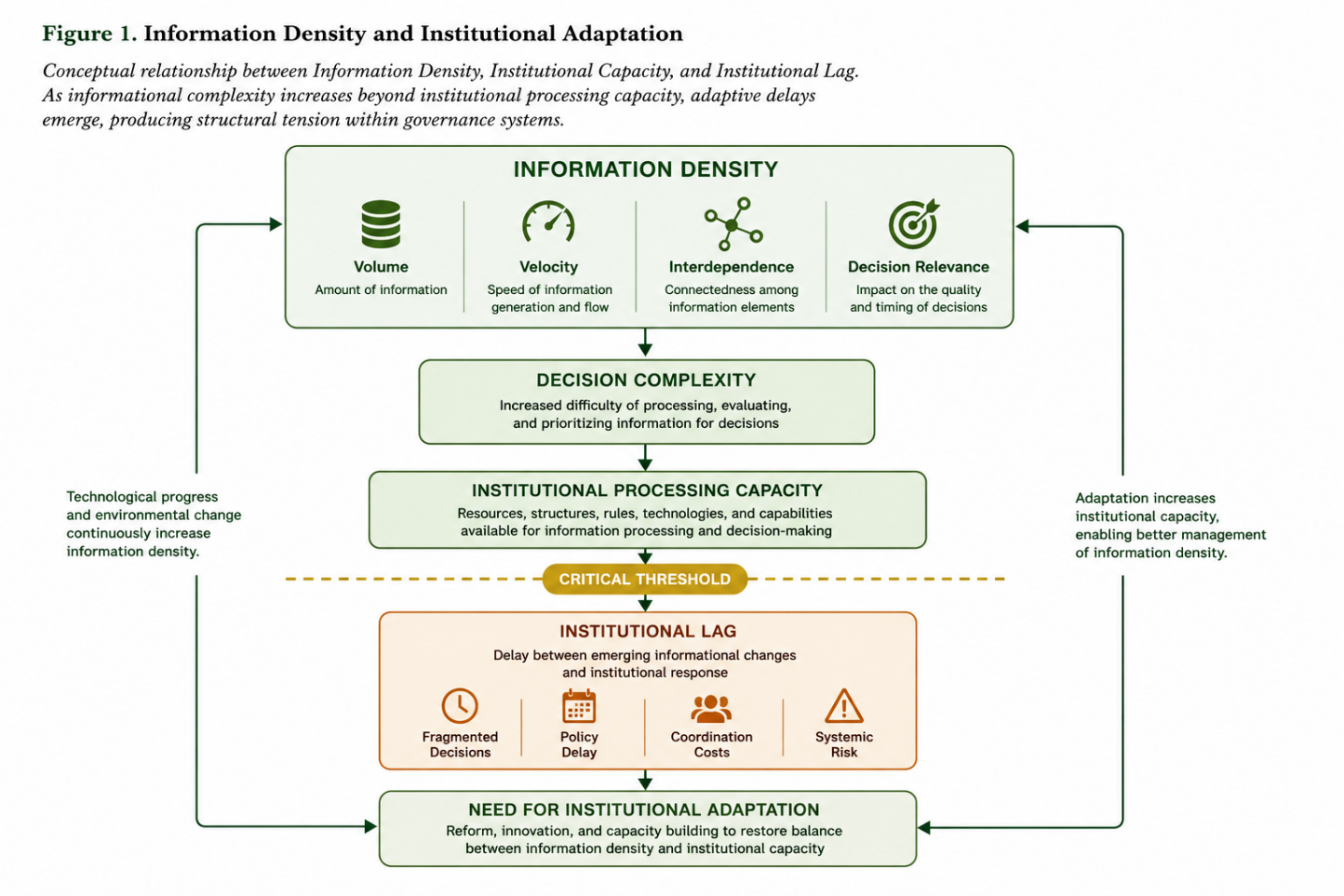
Information Density (ID) is the amount, velocity, interdependence, and decision relevance of information that must be processed by a cognitive, organizational, or institutional system within a given period of time in order to maintain effective adaptation and decision-making.
Unlike simple measures of information volume, Information Density incorporates four interrelated dimensions:
Volume — the quantity of information available to decision-makers;
Velocity — the speed at which new information is generated and must be processed;
Interdependence — the degree to which individual information elements influence one another;
Decision Relevance — the extent to which available information directly affects the quality and timing of decisions.
These dimensions interact rather than accumulate independently. As each increases, the overall informational complexity confronting institutions grows nonlinearly.
3.1 Information Density and Institutional Capacity
Every institution possesses a finite capacity to process information, evaluate alternatives, coordinate stakeholders, and implement decisions.
This capacity may be described as Institutional Capacity (IC).
Institutional Capacity depends on multiple factors, including organizational structure, governance mechanisms, legal procedures, technological infrastructure, human expertise, and the speed of collective decision-making.
Under conditions of relatively low information density, institutional capacity remains sufficient to support timely adaptation.
However, as Information Density increases, institutions devote progressively larger portions of their resources to information processing rather than decision execution.
Eventually, a critical threshold is reached where informational demands exceed institutional processing capacity.
The relationship may be expressed conceptually as:
If Information Density (ID) exceeds Institutional Capacity (IC), institutional adaptation becomes progressively delayed.
This condition produces Institutional Lag.
Importantly, Institutional Lag should not be interpreted as evidence of institutional failure.
Instead, it represents a structural consequence of the growing mismatch between informational complexity and adaptive capacity.
3.2 Institutional Lag
Institutional Lag describes the temporal gap between changes occurring within informational environments and the corresponding adaptation of institutional structures.
Unlike technological systems, institutions cannot instantly modify legal frameworks, governance architectures, administrative procedures, organizational routines, or established patterns of collective decision-making. Institutional change is inherently cumulative and depends on multiple sequential processes.
Effective institutional adaptation requires:
negotiation among stakeholders;
consensus formation;
legal and regulatory revision;
organizational learning;
resource reallocation;
public and political acceptance.
Each of these processes consumes time.
Consequently, even highly effective institutions may experience persistent adaptation delays whenever Information Density increases faster than institutional learning and decision-making capacity.
Institutional Lag should therefore be understood as an inherent property of adaptive governance operating under conditions of rapidly increasing informational complexity rather than as evidence of institutional inefficiency or poor governance.
In this perspective, institutional delay represents a structural consequence of informational acceleration rather than a failure of institutional design.
Definition 2. Institutional Capacity
Institutional Capacity (IC) is the ability of an institutional system to process information, coordinate stakeholders, generate decisions, and implement adaptive responses within an evolving informational environment.
Institutional Capacity is therefore not a static organizational characteristic but a dynamic property continuously interacting with Information Density.
3.3 Adaptive Equilibrium
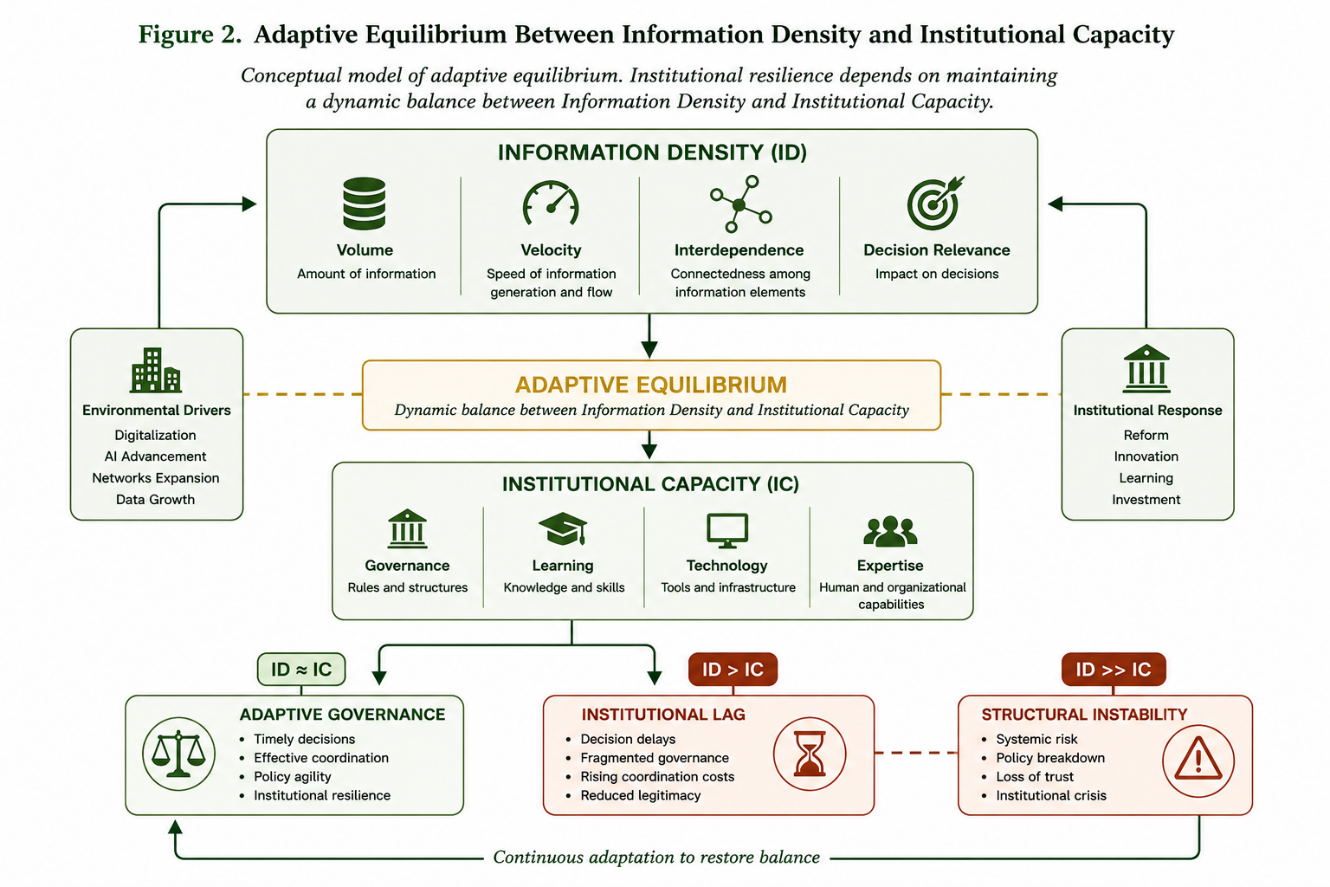
Adaptive systems do not require perfect synchronization between information growth and institutional development. Temporary adaptation delays are natural and often unavoidable. The stability of complex institutional systems depends instead on their ability to maintain a dynamic balance between informational demands and institutional processing capacity.
This dynamic balance is referred to in this paper as Adaptive Equilibrium.
Adaptive Equilibrium does not imply institutional stability in the traditional sense. Rather, it describes a continuously evolving condition in which institutions remain capable of processing increasing informational complexity without generating persistent institutional lag.
In rapidly changing environments, institutions continuously experience fluctuations in Information Density. Successful adaptation therefore depends not on eliminating informational growth but on expanding institutional capacity at a comparable rate.
When Information Density and Institutional Capacity evolve within compatible ranges, institutions remain capable of learning, coordinating stakeholders, updating governance mechanisms, and implementing timely decisions.
Conversely, when Information Density consistently exceeds Institutional Capacity, adaptive equilibrium gradually deteriorates. Decision delays accumulate, coordination costs increase, regulatory fragmentation expands, and institutional legitimacy may begin to decline.
Adaptive Equilibrium should therefore be understood as a dynamic property of institutional resilience rather than as a fixed organizational condition.
From this perspective, institutional sustainability depends less on organizational size or technological sophistication than on maintaining a continuously evolving balance between informational complexity and adaptive capacity.
Definition 3. Adaptive Equilibrium
Adaptive Equilibrium (AE) is the dynamic state in which Institutional Capacity remains sufficient to process prevailing Information Density without generating persistent Institutional Lag, thereby enabling continuous institutional adaptation under changing informational conditions.
Unlike static equilibrium concepts traditionally used in economics, Adaptive Equilibrium is inherently evolutionary. It assumes continuous environmental change and therefore requires continuous institutional learning, organizational adjustment, and governance innovation.
Figure 2
Adaptive Equilibrium Between Information Density and Institutional Capacity
4. Evidence and Illustrative Cases
The conceptual framework proposed in this paper is intended to explain a broad class of adaptive phenomena rather than a single institutional domain. Information Density is therefore illustrated through representative examples from rapidly evolving information environments where institutional adaptation has become increasingly challenging.
These examples do not constitute empirical validation in the statistical sense. Instead, they demonstrate the explanatory capacity of the proposed framework across different institutional contexts.
4.1 Artificial Intelligence Governance
The rapid development of generative artificial intelligence provides one of the clearest contemporary examples of increasing Information Density.
Within only a few years, governments have been required to address foundation models, autonomous agents, synthetic media, copyright, data governance, algorithmic accountability, cybersecurity, AI safety, and international regulatory coordination. Each new technological capability generates additional layers of legal, ethical, technical, and economic information that must be interpreted before effective regulation becomes possible.
Technological innovation proceeds continuously, whereas legislative procedures remain comparatively slow. Public consultations, expert evaluations, political negotiations, and legal harmonization require extended periods of institutional processing.
As a result, regulatory institutions frequently respond after technological capabilities have already evolved beyond the assumptions underlying existing legislation.
From the perspective developed in this paper, this phenomenon represents Institutional Lag produced by rapidly increasing Information Density rather than inadequate institutional performance.
4.2 Platform Economies
Digital platforms continuously generate new forms of economic coordination.
Ride-sharing services, online marketplaces, digital payment ecosystems, and algorithmic labor platforms simultaneously reshape employment relations, taxation, competition policy, consumer protection, and data governance.
Unlike traditional industries, platform economies evolve through continuous software updates, algorithmic optimization, and rapidly changing business models.
Institutions responsible for labor regulation, taxation, competition policy, and digital governance must therefore interpret increasingly interconnected informational environments.
Institutional adaptation becomes progressively more difficult as Information Density expands faster than legislative and administrative capacities.
Consequently, regulatory fragmentation often reflects informational complexity rather than policy failure.
4.3 Energy Transition and Climate Governance
The global transition toward low-carbon energy systems illustrates another environment characterized by rapidly increasing Information Density.
Governments, regulators, energy companies, financial institutions, and technology developers must simultaneously evaluate technological innovation, carbon markets, energy security, environmental regulation, investment risks, geopolitical developments, and long-term infrastructure planning.
Each decision requires the integration of scientific, economic, engineering, environmental, and political information originating from multiple interconnected sources.
Institutional Capacity therefore depends increasingly on interdisciplinary coordination rather than sector-specific expertise.
The proposed framework suggests that many governance challenges observed during the energy transition originate from the accelerating density of informational interactions rather than from deficiencies within individual institutions.
Although these examples originate from different domains, they exhibit a common structural pattern.
Rapid growth of Information Density increases Decision Complexity, which gradually approaches or exceeds Institutional Capacity. The resulting imbalance produces Institutional Lag and necessitates continuous institutional adaptation.
This recurring pattern suggests that Information Density may serve as a general conceptual variable for analyzing adaptive governance across multiple sectors of the digital economy.
5. Discussion
The concept of Information Density proposed in this paper shifts the analytical focus from information itself to the informational environment within which institutional decisions are made.
Traditional approaches generally evaluate information according to its quantity, accessibility, quality, asymmetry, or economic value. While these characteristics remain important, they do not adequately explain why institutions increasingly experience adaptation difficulties despite unprecedented advances in digital technologies and information processing.
The present framework suggests that institutional performance depends less on the absolute amount of available information than on the relationship between informational complexity and institutional processing capacity.
This distinction is fundamental.
Information Density is not a characteristic of individual datasets, documents, or communication channels.
Rather, it is a property of the decision environment itself.
As digital ecosystems become increasingly interconnected, institutions must simultaneously evaluate technical, legal, economic, environmental, political, and social information originating from multiple interacting sources.
The resulting complexity grows nonlinearly.
Consequently, institutional adaptation becomes progressively more dependent on the ability to manage informational relationships rather than merely increasing computational resources or expanding administrative procedures.
From this perspective, Institutional Lag should not be interpreted primarily as evidence of institutional inefficiency.
Instead, it represents a structural consequence of informational acceleration.
The central implication is that digital transformation creates not only new technological opportunities but also fundamentally new institutional conditions.
Successful institutions will therefore be distinguished less by organizational size or regulatory authority than by their capacity to continuously increase adaptive information processing.
This interpretation also extends beyond public governance.
Corporations, universities, healthcare systems, financial institutions, research organizations, and artificial intelligence ecosystems all operate within environments characterized by continuously increasing Information Density.
The proposed framework therefore offers a common conceptual language for analyzing adaptive performance across diverse institutional settings.
Importantly, the framework does not assume that increasing Information Density inevitably produces institutional failure.
Instead, it emphasizes the importance of maintaining Adaptive Equilibrium through continuous institutional learning, organizational innovation, technological modernization, and governance redesign.
Adaptive institutions are thus defined not by their resistance to change but by their capacity to evolve at a pace comparable to the informational environments they inhabit.
5.1 Theoretical Implications
The concept of Information Density contributes to contemporary institutional theory in three principal ways.
First, it introduces informational complexity as an independent analytical variable influencing institutional adaptation.
Second, it provides a unified conceptual framework connecting information economics, institutional theory, complexity science, and decision theory.
Third, it explains Institutional Lag as a structural property of adaptive systems rather than as an indicator of managerial or political failure.
Taken together, these contributions suggest that future institutional analysis may benefit from evaluating not only institutional structures but also the informational environments within which those structures operate.
6. Practical Implications
The concept of Information Density has practical implications across multiple domains of governance, organizational management, and strategic decision-making.
For public administration, the framework provides a conceptual basis for understanding why regulatory systems frequently experience adaptation delays during periods of rapid technological change. Rather than interpreting these delays solely as governance failures, policymakers may evaluate whether existing institutional capacity remains proportional to the informational demands of the environment.
For organizations and corporations, Information Density offers a new perspective on organizational resilience. Decision quality increasingly depends not only on access to information but also on the ability to organize, prioritize, and continuously integrate expanding informational flows into coherent strategic actions.
Within artificial intelligence governance, the framework highlights the importance of adaptive regulatory mechanisms capable of evolving alongside technological innovation. Static regulatory approaches become progressively less effective as Information Density continues to increase.
For higher education and research institutions, the proposed concept suggests that educational systems should increasingly emphasize interdisciplinary integration, systems thinking, and adaptive decision-making rather than the accumulation of isolated disciplinary knowledge.
More broadly, Information Density provides a conceptual tool for evaluating institutional readiness under conditions of accelerating digital transformation and growing informational complexity.
7. Future Research
The framework proposed in this paper represents a conceptual foundation rather than a completed theory.
Several directions for future research appear particularly promising.
The first concerns the development of quantitative indicators capable of measuring Information Density across different institutional environments. Such indicators may combine measures of informational volume, velocity, interdependence, and decision relevance into composite indices suitable for comparative institutional analysis.
A second direction involves the empirical measurement of Institutional Capacity and Institutional Lag across governments, corporations, universities, healthcare systems, and other adaptive organizations.
Future studies may also investigate how advances in artificial intelligence influence institutional processing capacity and whether AI-assisted governance can partially compensate for increasing Information Density without introducing new forms of systemic risk.
Finally, the concept of Information Density may be integrated with broader frameworks of decision reliability, meaning formation, and adaptive cognition, providing opportunities for interdisciplinary research across economics, information science, governance, cognitive systems, and artificial intelligence.
8. Conclusion
The digital transformation of society has fundamentally altered the conditions under which institutions operate.
Information is no longer scarce. Instead, contemporary institutions increasingly function within environments characterized by continuously growing informational complexity.
This paper has proposed Information Density as a conceptual category for describing that complexity and explaining its relationship to institutional adaptation.
Unlike traditional approaches that focus primarily on information quantity or technological development, the proposed framework emphasizes the interaction between Information Density and Institutional Capacity. Institutional Lag emerges not simply because institutions perform poorly, but because informational environments evolve more rapidly than institutional learning and adaptive processes.
By introducing the concepts of Information Density, Institutional Capacity, Institutional Lag, and Adaptive Equilibrium within a unified conceptual framework, this study offers a broader perspective on institutional resilience under conditions of accelerating digital transformation.
Although the framework remains conceptual, it establishes a foundation for future empirical research capable of measuring informational complexity and evaluating institutional adaptability across diverse governance environments.
Ultimately, the central challenge of the twenty-first century may not be technological acceleration itself, but the capacity of institutions to remain adaptive within increasingly complex information environments.
Understanding Information Density may therefore become as important for institutional theory as understanding capital was for industrial economics and understanding information was for the emergence of the digital economy.
Acknowledgements
The author gratefully acknowledges the use of artificial intelligence as a collaborative research assistant during manuscript preparation. AI tools supported language refinement, structural editing, visualization development, and conceptual discussion. All theoretical concepts, analytical interpretations, definitions, and conclusions presented in this article remain the sole responsibility of the author.
Funding
This research received no external funding.
Conflict of Interest
The author declares no conflict of interest.
AI-Assisted Research Disclosure
Artificial intelligence tools were used to assist with language editing, structural refinement, visualization design, and editorial review. AI did not generate the conceptual framework, theoretical contributions, or scientific conclusions presented in this article. Responsibility for the content remains entirely with the author.
References
Acemoglu, D., & Johnson, S. (2023). Power and progress: Our thousand-year struggle over technology and prosperity. PublicAffairs.
Arthur, W. B. (2009). The nature of technology: What it is and how it evolves. Free Press.
Ashby, W. R. (1956). An introduction to cybernetics. Chapman & Hall.
Bar-Yam, Y. (1997). Dynamics of complex systems. Addison-Wesley.
Beer, S. (1972). Brain of the firm. Allen Lane.
Brynjolfsson, E., & McAfee, A. (2014). The second machine age: Work, progress, and prosperity in a time of brilliant technologies. W. W. Norton & Company.
Bykovski, A. (2025). The search function of capital: Why some investment bubbles build the future. SSRN.
Bykovski, A. (2025). The myth of secret commands: Semantic compression, cognitive compatibility, and meaning drift in Human–AI systems. SSRN.
Castells, M. (2010). The rise of the network society (2nd ed.). Wiley-Blackwell.
Hayek, F. A. (1945). The use of knowledge in society. American Economic Review, 35(4), 519–530.
Kahneman, D. (2011). Thinking, fast and slow. Farrar, Straus and Giroux.
Meadows, D. H. (2008). Thinking in systems: A primer. Chelsea Green Publishing.
Minsky, H. P. (1986). Stabilizing an unstable economy. Yale University Press.
North, D. C. (1990). Institutions, institutional change and economic performance. Cambridge University Press.
Shannon, C. E. (1948). A mathematical theory of communication. Bell System Technical Journal, 27(3), 379–423.
Shannon, C. E., & Weaver, W. (1949). The mathematical theory of communication. University of Illinois Press.
Simon, H. A. (1947). Administrative behavior. Macmillan.
Simon, H. A. (1969). The sciences of the artificial. MIT Press.
Srnicek, N. (2017). Platform capitalism. Polity Press.
Weick, K. E. (1995). Sensemaking in organizations. Sage Publications.
Zuboff, S. (2019). The age of surveillance capitalism. PublicAffairs.
EX-JICS