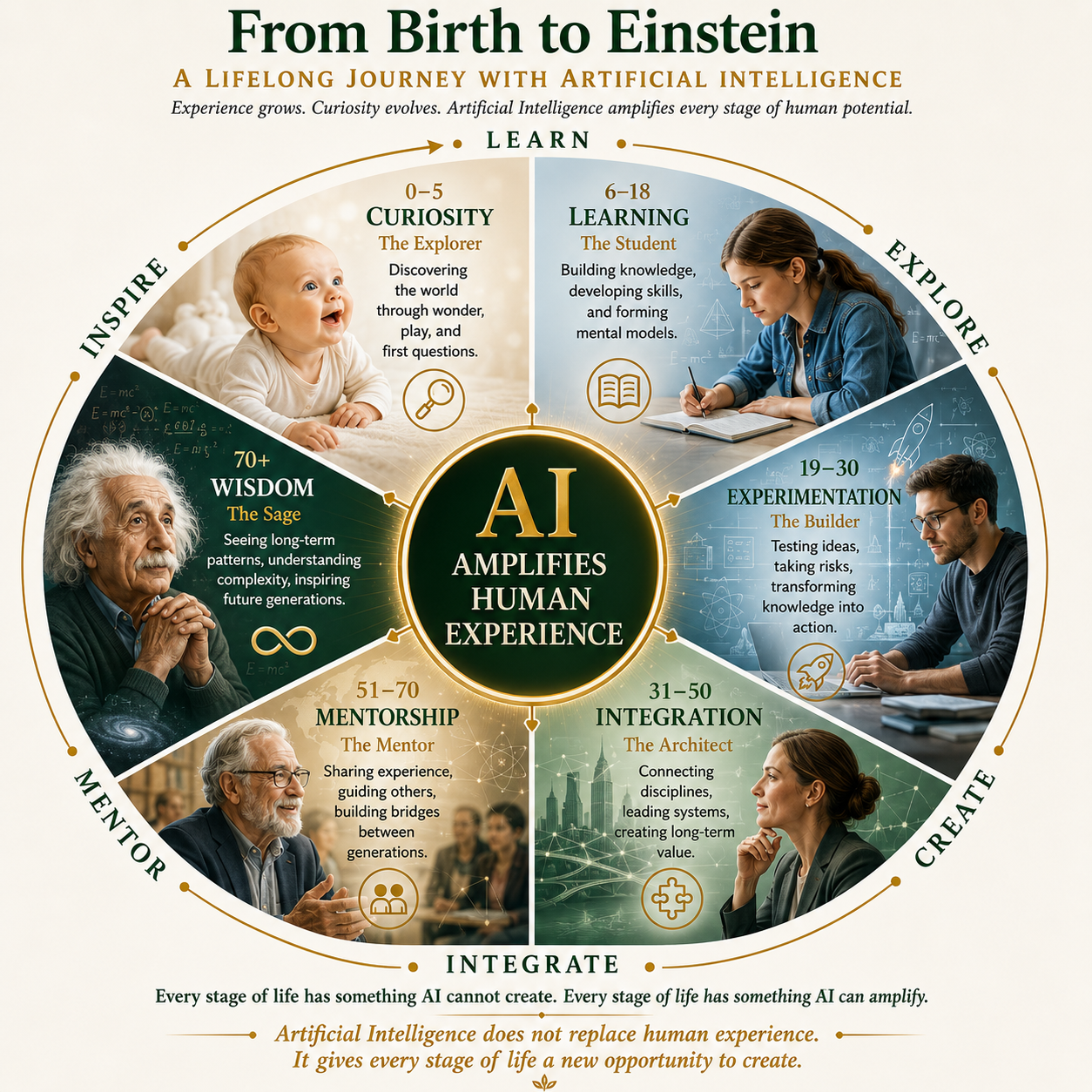
AI Is Not for the Young. AI Is for the Experienced.
And the Future Belongs to Those Who Unite Both — Perspective / Editorial Essay, Vol. 1 No. 1
Volume 1 • Issue 1 • June 2026
AI Is Not for the Young.
AI Is for the Experienced.
And the Future Belongs to Those Who Unite Both
Perspective / Editorial Essay
Alexander Bykovski, EnergeticaX Institute Ltd
Correspondence: journal@energeticax.org
Abstract
Artificial intelligence is often perceived as a technology primarily belonging to younger generations. This essay challenges that assumption. It argues that AI does not create thinking by itself, but amplifies the cognitive architecture already present in the user. For this reason, accumulated professional experience, interdisciplinary judgment, and the ability to reinterpret one’s own models of reality may become more valuable, not less valuable, in the AI era. The essay proposes that the future of work, innovation, and decision-making will not belong either to the young or to the experienced alone, but to cognitive partnerships that combine speed, adaptability, data fluency, systemic understanding, and human context.
Keywords
Artificial Intelligence; Experience; Cognitive Cooperation; Human–AI Interaction; Intergenerational Collaboration; Decision Intelligence; Professional Expertise.
The Numbers That Surprise
Artificial intelligence has entered human history at unprecedented speed.
Today, more than a billion people regularly interact with generative AI. If embedded AI functions in smartphones, search engines, navigation systems, and digital assistants are included, interaction with artificial intelligence has already become part of everyday life for much of humanity.
At first glance, the conclusion seems obvious.
AI appears to belong to the young.
Younger generations adopt new tools quickly. They experiment without fear. They move naturally between platforms, interfaces, and digital environments.
Older professionals, by contrast, often adopt AI more slowly. Many have never opened a language model out of curiosity. Others perceive AI as a threat to their accumulated expertise.
And yet this may conceal one of the greatest misunderstandings of the AI era.
The Amplification Paradox
Artificial intelligence does not create thinking.
It amplifies the cognitive architecture that already exists.
A young specialist equipped with AI can generate content quickly. But speed alone does not guarantee depth. AI can produce beautiful superficiality: text without judgment, code without architecture, analysis without understanding of consequences.
An experienced professional enters the interaction differently.
Years of solving real problems, making mistakes, observing people, understanding systems, and recognizing hidden relationships become cognitive capital.
AI dramatically increases the productivity of that capital.
It reduces the distance between thought and implementation.
The richer the thought, the stronger the amplification.
This is the paradox:
AI amplifies accumulated experience more powerfully than accumulated information.
The Main Barrier Is Not Age
The greatest barrier for experienced professionals is often not age.
It is inertia.
Many see AI as a threat to professional identity. Others fear that companies will extract their knowledge, train machines on it, and then make them unnecessary.
This fear is understandable.
But it rests on a misunderstanding.
Knowledge is not the same as thinking.
If professional value consisted only of instructions, formulas, and archives, then AI could replace experience after digitizing it.
But real expertise lies deeper.
It lives in exceptions, anomalies, hidden relationships, failed decisions, practical intuition, and the ability to understand why a formally correct solution may fail in reality.
AI can store knowledge.
It cannot automatically reproduce lived context.
AI Amplifies Errors Too
There is also an uncomfortable truth.
AI amplifies not only mature thinking, but also false assumptions.
An experienced person with an outdated model of the world can use AI to produce more convincing, more structured, and more scalable errors.
AI is not a source of truth.
It is an amplifier of cognitive structure.
Therefore, the key skill of the AI era is not merely the ability to use neural networks.
It is the ability to revise one’s own models of reality.
Experience that does not adapt becomes dogma.
Dogma amplified by AI becomes dangerous.
The Old Paradigm Is Breaking
The twentieth century was built around narrow specialization.
One person.
One profession.
One career track.
One vertical system of knowledge transmission.
That model made sense when information was scarce, knowledge changed slowly, and professional problems remained largely inside disciplinary boundaries.
Those conditions no longer exist.
Climate is not only physics. It is energy, economics, politics, psychology, and infrastructure.
Modern medicine is not only biology. It is AI, data, logistics, ethics, and governance.
Urban infrastructure is not only engineering. It is mobility, digital platforms, finance, energy, and human behavior.
The world has become too complex for narrow tunnels of thinking.
The rarest competence is no longer depth inside one tunnel.
It is the ability to connect tunnels.
The Third Player: Data
In the AI era, a third element becomes decisive: data.
Young professionals often adapt faster to tools for collecting, processing, and visualizing data. AI can structure enormous volumes of information and identify hidden correlations.
But data are not knowledge.
Data may be incomplete, biased, decontextualized, or wrongly interpreted.
Value emerges only when data are interpreted within a living system of meaning.
Modern creation therefore requires three elements at once:
speed in working with data;
AI-enabled processing;
and human understanding of context.
AI increases the value not of information alone, but of integrated thinking.
Not a Generational Replacement
Society still thinks in terms of conflict:
young against old;
new against old;
technology against experience.
AI makes this model obsolete.
Young generations bring speed, flexibility, experimentation, and rapid adoption of tools.
Experienced professionals bring systems thinking, historical memory, engineering judgment, and awareness of long-term consequences.
This is not competition.
It is mutual amplification.
The young specialist asks:
How can we build it?
The experienced specialist asks:
Why should we build it, and what happens after it works?
One brings tools.
The other brings context.
AI becomes the bridge between them.
Manifesto of a New Era
The AI era requires a new architecture of human cooperation.
First, AI is not a tool for the young. It is an amplifier for those who have something meaningful to amplify.
Second, the future cannot be built within narrow professional corridors. Value increasingly belongs to synthesis: the ability to hold technological, economic, and human dimensions together.
Third, the future belongs neither to the young nor to the experienced alone. It belongs to those who can build cognitive partnerships.
Fourth, AI creates, for the first time, the technical possibility of such partnerships at global scale.
Conclusion
The twenty-first century does not require a replacement of generations.
It requires their integration.
This is not a romantic appeal to cooperation. It is a practical conclusion about where real value emerges when routine operations are increasingly performed by machines.
The future belongs to cognitive partnerships in which human experience, interdisciplinary thinking, adaptive speed, data, and artificial intelligence operate as a single environment of creation.
Artificial intelligence does not diminish the value of experience.
It changes the way experience creates value.
For the first time in history, accumulated human knowledge, adaptive learning, and intelligent machines can operate within one cognitive ecosystem.
The future will belong not to artificial intelligence alone, nor to human intelligence alone, but to their ability to create meaning together.
Author's Reflection
This essay reflects the author's personal observations accumulated through decades of work in engineering, economics, education, organizational development, and artificial intelligence. Rather than presenting empirical research, it offers a perspective on how AI may reshape the relationship between knowledge, experience, and human creativity.